


Introduction
With the explosive growth of the low-altitude economy, unmanned urban logistics, and Urban Air Mobility (UAM), monitoring and tracking low-altitude flight targets has become a critical challenge for airspace safety and privacy protection. Traditional surveillance methods, such as radar and computer vision, often encounter blind spots when detecting low-altitude, slow-moving, or small composite-material targets, especially in complex lighting or dense urban environments.
To overcome these limitations, edge-computing-based acoustic localization technology has emerged as a highly cost-effective, all-weather, and passive alternative. By capturing hardware-synchronized audio using digital Microelectromechanical Systems (MEMS) microphones, industrial systems can perform highly accurate low-altitude acoustic profiling and real-time sound source localization (SSL). In this article, we delve into the core mechanics of linear microphone array configurations and explore how advanced hardware platforms bridge the gap between academic theory and industrial deployment.
1. Core Advantages of Microphone Arrays in Acoustic Profiling
A low-altitude target generates a distinct acoustic signature primarily driven by its motors and propellers. While a single-channel microphone can only capture sound pressure amplitude, a strategically arranged array of multiple microphones enables combined digital signal processing to yield substantial systemic advantages:
- Spatial Directivity: Amplifies acoustic waves capturing sound from a precisely defined direction.
- Point-Source Noise Suppression: Attenuates non-stationary environmental noise and targetless interference.
- Acoustic Tracking: Enables spatial localization, continuously tracking a moving point sound source over time.
- Reverberation Mitigation: Partially weakens multi-path reflections in complex urban topologies or mountainous terrains.
2. Array Architectures: Broadside vs. Endfire Formations
When designing an acoustic profiling system, the geometric arrangement of the sensors determines the array’s directional response. The two foundational configurations discussed in contemporary research are Broadside and Endfire structures:
The Broadside Structure
In a Broadside configuration, omnidirectional microphones are positioned perpendicular to the direction of the desired signal.
- Characteristics: It possesses an axis of symmetry, allowing sound pressure waves to pass without attenuation both in front of and behind the array.
- Frequency Dependency: A major drawback of the Broadside layout is its heavy reliance on signal frequency. For instance, a two-element Broadside array with a 7.5 cm spacing exhibits clear directional characteristics at 4 kHz, but becomes essentially omnidirectional at lower frequencies (e.g., 1 kHz), failing to achieve effective spatial filtering at the lower spectrum of acoustic signatures.
The Endfire Structure (Differential Microphone Arrays)
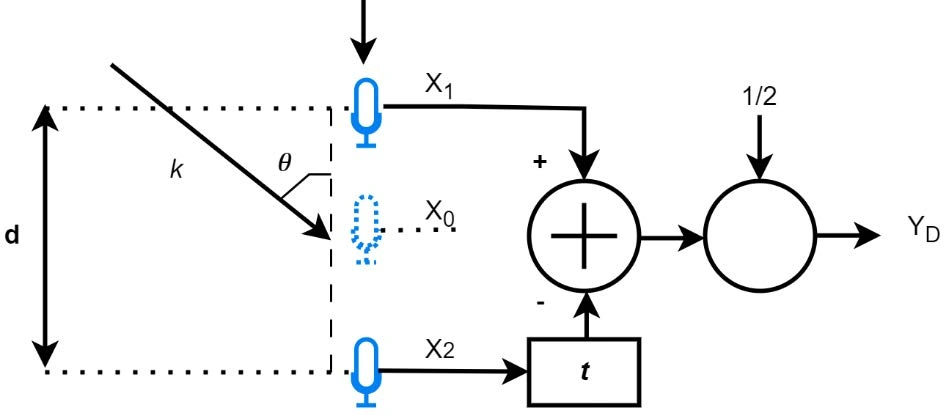
An Endfire structure aligns multiple microphones along the path of the incoming useful acoustic wave. By summing a delayed signal from the front microphone with the signal from the rear element, developers can construct a differential array that forms a cardioid, hypercardioid, or supercardioid directional pattern.
- Characteristics: It theoretically eliminates sounds incident at $180^\circ$, making it highly directional and compact.
- The Low-Frequency Challenge: While First-Order and Higher-Order Differential Microphone Arrays (DMAs) offer superb off-axis rejection in small physical form factors, their directional function behaves like a first-order high-pass filter. At lower frequencies, the differential output becomes highly sensitive to parameter mismatches (such as sensitivity and phase drift) between individual microphones. Any slight variation gets amplified heavily by the equalization filters ($W_{eq}(\omega)$) required to stabilize the circuit, posing a strict requirement for hardware precision.
3. Bridging the Gap: High-Channel Digital MEMS Arrays
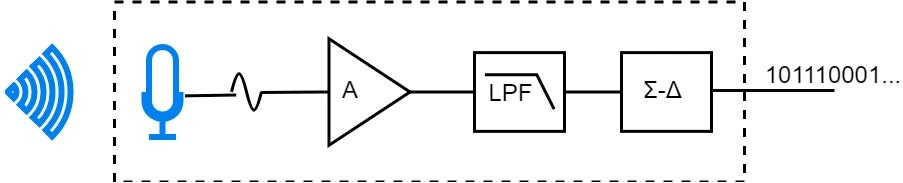
To overcome the limitations of analog parameter drift and to satisfy the extreme clock synchronization required by advanced localization algorithms, real-world edge applications must transition to high-density digital architectures.
The SV-SSL 64-Channel MEMS Microphone Array Development Platform developed by Wuxi Silicon Source Technology Co., Ltd. (SISTC) is specifically engineered to handle these intense low-altitude acoustic profiling demands.
The hardware parameters of the SV-SSL64 platform perfectly resolve the core bottlenecks of acoustic source localization:
- Nanosecond-Level Hardware Synchronization: Every digital MEMS microphone on the platform shares a synchronized master clock, ensuring pristine Time Difference of Arrival (TDOA) and Generalized Cross-Correlation (GCC-PHAT) performance without software buffer jitter.
- Massive Spatial Sampling Channels: Supporting up to 64 parallel channels of high-performance MEMS microphones, the platform provides unmatched spatial resolution for high-order beamforming, eliminating spatial aliasing and vastly boosting the signal-to-noise ratio (SNR).
- Edge Computing Ready: The native digital pulse-density modulation (PDM) stream is converted seamlessly, allowing developers to deploy high-tier algorithms directly on edge processors—including MUSIC, ESPRIT, Steered Response Power (SRP), and Convolutional Recurrent Neural Networks (CRNN).
4. Processing Pipeline: From Raw Audio to Spatial Trajectories
To extract actionable positioning telemetry from an incoming low-altitude acoustic target, the edge infrastructure executes a robust signal-processing pipeline:
[Synchronized MEMS Capture] -> [Digital PDM Decimation & Filtering] -> [Time Delay Estimation (TDOA)] -> [Spatial Triangulation / Beamforming] -> [Trajectory Output]
- Time Delay of Arrival (TDOA): The cross-correlation between synchronized channels yields microsecond-level delay parameters, which are crucial for subsequent triangulation equations.
- Data Association & Multi-Source Tracking: When handling complex environments with multiple overlapping noise emissions, modified algorithms (such as Global Nearest Neighbor, GNN-c) ensure real-time, low-latency association between localization vectors and target sound sources.
- Sensor Fusion & Deep Learning: By leveraging Short-Time Fourier Transforms (STFT) and training neural networks on specific acoustic profiles, systems can simultaneously recognize and track targets. Integrating this data with secondary civilian sensors, like LiDAR (6-DoF) or optical cameras, builds an uncompromised, comprehensive situational awareness matrix.
Conclusion
Acoustic profiling and sound source localization using digital MEMS microphone arrays are transforming from theoretical research into vital civil industrial solutions. By picking high-performance, fully synchronized, multi-channel hardware platforms, engineers can bypass the traditional pitfalls of sensor mismatch and low-frequency noise amplification.
To explore the detailed technical specifications of our 64-channel matrix and accelerate your edge computing deployment, visit our official product gateway:
👉 SISTC SV-SSL 64-Channel MEMS Microphone Array Development Platform
Technical & Academic References
To support further engineering research into spatial audio beamforming and low-altitude monitoring frameworks, consider reviewing these official standards and technical publications:
- IEEE Signal Processing Society — Leading research hub for advanced microphone array signal processing, direction-of-arrival (DOA) estimation, and acoustic edge computing methodologies.
- The Journal of the Acoustical Society of America (JASA) — Premier academic publication featuring definitive studies on machine learning in acoustics, deep-learning source localization, and multi-frequency spatial arrays.
- Audio Engineering Society (AES) — The international authority governing digital audio interfacing standardizations, electro-acoustic parameters, and microphone array measurement architectures.