


In Part 1, we introduced the fundamentals of microphone arrays and beamforming.
Now, we move into the engineering core—how a 2-microphone (dual-mic) array actually works, and why it remains the foundation of most modern voice systems.
Despite its simplicity, the dual-mic array reveals nearly all the critical principles behind advanced array architectures.
Why Start with a 2-Microphone Array?
A microphone array can consist of dozens—or even hundreds—of elements.
However, every complex array can be reduced to interactions between pairs of microphones.
This makes the dual-mic array the fundamental building block for:
- Smart speakers
- AI voice modules
- Wearables
- Automotive voice systems
At SISTC, many optimized solutions begin with dual-MEMS microphone architectures, then scale into multi-channel arrays.
👉 Explore our MEMS microphone portfolio:
https://sistc.com/product-category/mems-microphone/
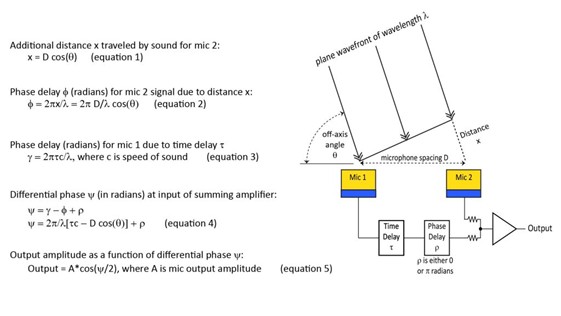
The Key Concept: Phase Difference
When a sound wave reaches two microphones placed at a distance D, it arrives at slightly different times.
This creates a phase difference, which determines whether signals:
- Reinforce each other (constructive interference)
- Cancel each other (destructive interference)
What affects phase difference?
- Microphone spacing (D)
- Sound frequency (λ)
- Arrival angle (θ)
- Applied delay (τ)
- Phase inversion (ρ)
This relationship is the core mechanism behind beamforming.
Two Fundamental Array Types
Dual-mic arrays can operate in two main modes:
1. Additive Array (Summation Mode)
Working principle:
- Signals are added together
- Optional time delay aligns signals from a target direction
Characteristics:
- Flat frequency response (on-axis)
- Strong signal gain
- Directionality depends on frequency
Typical configurations:
- Broadside array
- Endfire array
2. Differential Array (Subtraction Mode)
Working principle:
- One signal is inverted and subtracted
- Output = difference between microphones
Characteristics:
- Strong directionality even at low frequencies
- Built-in noise suppression
- Limited bandwidth (low-frequency roll-off + high-frequency aliasing)
Broadside vs Endfire: Directional Behavior
Broadside Array
- Maximum sensitivity perpendicular to mic axis
- Symmetrical pickup pattern
Endfire Array
- Maximum sensitivity along the mic axis
- Strong forward focus
👉 Endfire arrays are widely used in:
- Smart speakers
- Voice assistants
- Automotive cabins
From Omni to Cardioid: Pattern Formation
By adjusting delay and phase, dual-mic arrays can create classic directional patterns:
| Pattern | Description |
|---|---|
| Omnidirectional | Equal sensitivity in all directions |
| Dipole (Figure) | Two opposite lobes |
| Cardioid | Forward-focused pickup |
| Supercardioid | Narrower front lobe |
| Hypercardioid | Highest directivity |
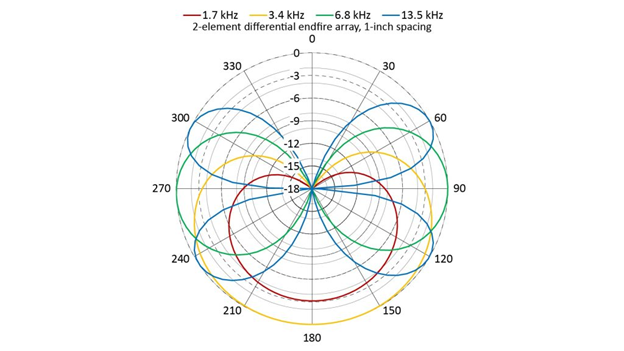
These patterns are essential for voice isolation in noisy environments.
SNR Improvement in Dual-Mic Arrays
A key advantage of dual-mic arrays is SNR enhancement.
When signals align:
- Signal power increases by +6 dB
- Noise power increases by +3 dB
👉 Net improvement:
+3 dB SNR gain
This is critical for:
- Far-field voice pickup
- Low-power AI devices
- Edge computing systems
The Trade-offs Engineers Must Consider
Designing a dual-mic array involves multiple trade-offs:
1. Microphone Spacing (D)
- Larger spacing → better directionality
- But → earlier spatial aliasing
2. Frequency Dependency
Additive arrays:
- Lose directionality at low frequencies
Differential arrays:
- Maintain directionality
- But suffer from bandwidth limitations
3. Noise Sensitivity
Differential arrays:
- More sensitive to mismatch between microphones
- Require precise calibration
4. Implementation Complexity
Adding:
- Time delay
- Phase control
- Gain weighting
increases system complexity—especially in real-time AI applications.
How SISTC Optimizes Dual-Mic Performance
At SISTC, we go beyond basic array design by integrating:
✅ High-consistency MEMS microphones
- Tight sensitivity matching
- Low self-noise
✅ Advanced noise reduction algorithms
- Adaptive filtering
- AI-based voice enhancement
✅ Hardware + software co-design
- Signal conditioning circuits
- Embedded processing modules
👉 Explore our integrated solutions:
https://sistc.com/product-category/sensor-module/
Real-World Applications
Dual-mic arrays are widely used in:
- Smart home voice control
- Bluetooth headsets
- Automotive voice systems
- Industrial voice interfaces
They provide an optimal balance between:
- Performance
- Cost
- Power consumption
Conclusion
The dual-microphone array is the foundation of modern beamforming systems.
By leveraging:
- Phase difference
- Time delay
- Signal subtraction
it enables:
- Directional audio capture
- Noise suppression
- Efficient voice interaction
In the next article, we will explore how multi-element arrays (N-mic systems) dramatically enhance performance—and what it takes to design them effectively.
References
- Analog Devices application note AN-1328, available at https://www.analog.com/media/en/technical-documentation/application-notes/AN-1328.pdf [accessed June 2021]. Describes principle of operation, design, and construction of professional grade studio or live performance microphone using up to 32 analog MEMS microphones connected to op amps and a difference amplifier. Design is a volumetric array consisting of two additive broadside arrays in a differential end-fire configuration.
- TDK InvenSense applicaton note AN-1140, available at https://invensense.tdk.com/wp-content/uploads/2015/02/Microphone-Array-Beamforming.pdf [accessed June 2021]. Discusses basic principles and performance of various array configurations.