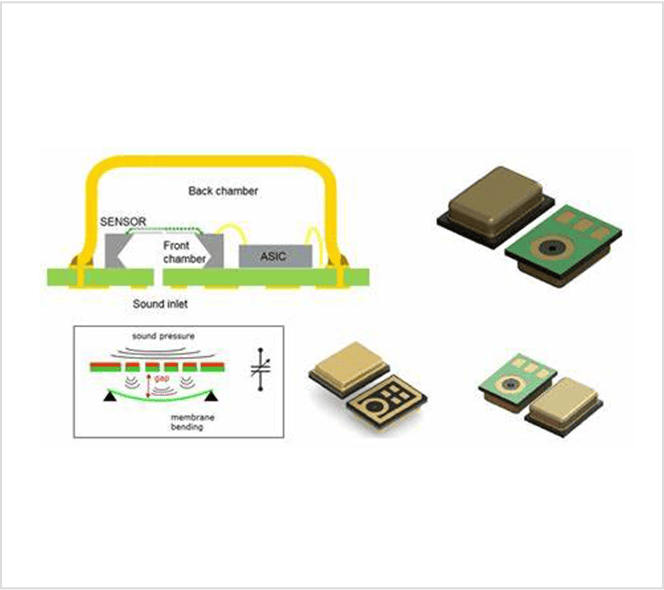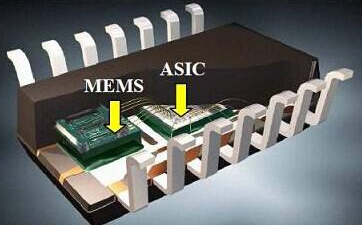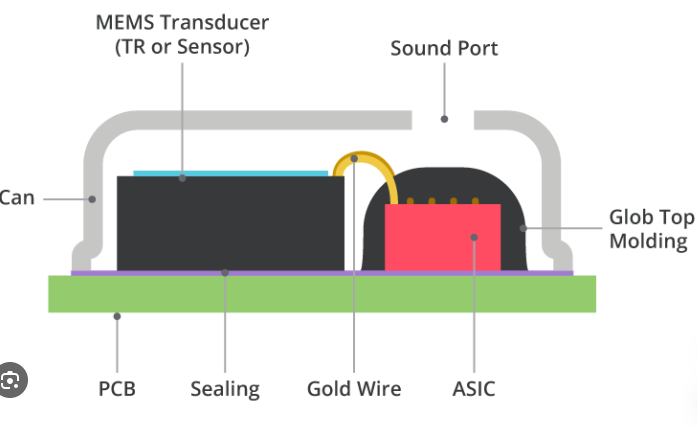


When designing the front-end of a MEMS microphone signal chain, choosing the right operational amplifier (op-amp) is essential to achieving optimal audio performance. The preamplifier not only amplifies the tiny analog signal from the MEMS microphone but also plays a critical role in maintaining the signal-to-noise ratio (SNR), maximizing dynamic range, and minimizing distortion.
Why Op-Amp Selection Matters for MEMS Microphones
MEMS microphones—such as the ADMP504—typically offer sensitivities around −38 dBV and an SNR of 65 dB, with inherent self-noise in the range of −103 dBV. To preserve this performance, the preamplifier’s op-amp noise floor should be at least 10 dB lower, ideally below −113 dBV, corresponding to a voltage noise density of around 15.9 nV/√Hz or better over a 20 kHz bandwidth.
🔗 Looking for MEMS microphones designed for low-noise audio applications?
Visit our product catalog
Key Parameters When Choosing an Op-Amp for MEMS Audio Preamps
1. Noise Performance
Noise is divided into:
- Voltage noise (dominant)
- Current noise (relevant with high-resistance sources)
Choose op-amps with low voltage noise density, ideally under 10 nV/√Hz for most applications. For example, the ADA4075-2 exhibits a noise voltage of just 0.395 μV over a 20 kHz bandwidth, translating to −128 dBV—well below the MEMS mic noise floor.
📘 Pro Tip: Avoid using high-value resistors (>10 kΩ) in your input network to keep current noise minimal.
2. Slew Rate
Slew rate defines how quickly the op-amp output can change. For full-range audio signals (e.g., 8.5 VRMS output, or 12 V peak at 20 kHz), the required slew rate is:
Slew Rate ≥ 2π × fMAX × Vpeak = 1.5 V/μs
Even though real-world audio signals rarely push this hard, an op-amp that meets or exceeds this requirement ensures headroom under high-level transients.
3. Total Harmonic Distortion + Noise (THD+N)
Low THD+N is critical for audio clarity. It is expressed either in % or dB and typically depends on:
- Output swing
- Load impedance
- Internal linearity of the op-amp
Op-amps designed for audio should provide <0.001% THD+N at typical output levels to maintain transparency across the chain.
4. Power Efficiency
In battery-powered systems, such as wearables or portable recorders, low quiescent current is a must. Select op-amps that:
- Support rail-to-rail operation
- Work efficiently at low voltages (1.8–3.3 V)
- Balance performance vs. current draw (e.g., <500 μA)
Some op-amps offer shutdown modes to reduce idle power even further.
Additional Design Considerations
- Bandwidth: Ensure the op-amp supports at least 100 kHz bandwidth for full-range audio transparency.
- Package Type: Choose ICs available in compact SOT-23, SC70, or WLCSP packages for integration into miniature preamp PCBs.
- PSRR and CMRR: High power-supply and common-mode rejection help minimize interference in mixed-signal environments.
Summary
When designing a MEMS microphone preamplifier, you need to optimize around:
- Voltage noise density
- Slew rate
- THD+N
- Power consumption
Selecting an op-amp that balances all of these ensures the microphone output signal is amplified cleanly, accurately, and efficiently, resulting in better system-level audio fidelity.
💡 Explore MEMS microphones that pair perfectly with low-noise preamp designs in our product section