

ntroduction
With the rapid evolution of voice-first interfaces, smart wearables, and edge-AI audio systems, the demand for high-performance, low-power digital microphones is growing. One major technical challenge is achieving a wide dynamic range (DR) while maintaining minimal power consumption and a compact form factor.
At Wuxi Silicon Source Technology Co., Ltd. (SiSTC), we continue to explore cutting-edge technologies like Electrostatic Force Feedback Control (EFFC) to push the boundaries of CMOS-MEMS microphone performance.
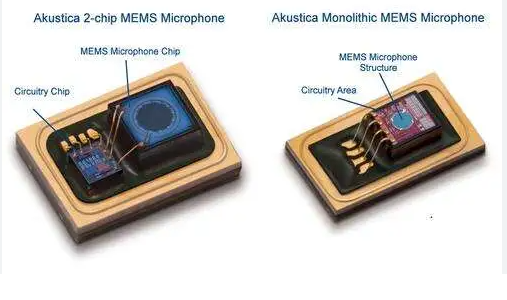
Overview of EFFC-Based MEMS Microphone Architecture
The proposed microphone architecture integrates a novel Electrostatic Force Feedback Control (EFFC) system that dynamically adjusts the biasing of the MEMS sensor based on input amplitude. This approach enables:
- 📈 Adaptive mechanical gain, acting before the analog front end (AFE)
- 🔧 Relaxed noise requirements for readout electronics
- ⚡ Lower power consumption with high signal integrity
By applying electrostatic feedback force in real-time, the system modulates sensitivity depending on input SPL (Sound Pressure Level), effectively extending the acoustic dynamic range without sacrificing low-end sensitivity or high-end overload handling.
Key Technical Features
✅ Capacitive Feedback Instrumentation Amplifier (CFB IA)
Traditional resistive-feedback amplifiers (RFB IAs) contribute significant thermal noise. This design replaces them with a capacitive-feedback IA featuring:
- Adjustable gain
- Enhanced low-noise performance
- Better linearity across SPL spectrum
✅ Sub-Sampling Amplitude Detector (SSAD)
To detect real-time acoustic energy efficiently, a low-power SSAD is implemented using:
- Cascaded low-order decimation filters
- Real-time acoustic volume estimation
- High-resolution SPL tracking
✅ Predictive Reference Charge Pump (PRCP)
The PRCP module fine-tunes the MEMS bias voltage with high accuracy using:
- Closed-loop control architecture
- Prediction logic to shorten settling time
- Fast response to dynamic input changes
Measured Performance
| Parameter | Value |
|---|---|
| Signal-to-Noise Ratio (SNR) | 68.2 dB @ 94 dB SPL |
| Acoustic Overload Point (AOP) | 133 dB SPL |
| Acoustic Dynamic Range (DR) | 107.2 dB |
| Power Consumption | 430 μA @ 3.072 MHz clock |
This level of performance makes the proposed system ideal for applications requiring both whisper-level sensitivity and shout-level overload tolerance.
Applications and Market Relevance
EFFC-based MEMS microphones are well-suited for:
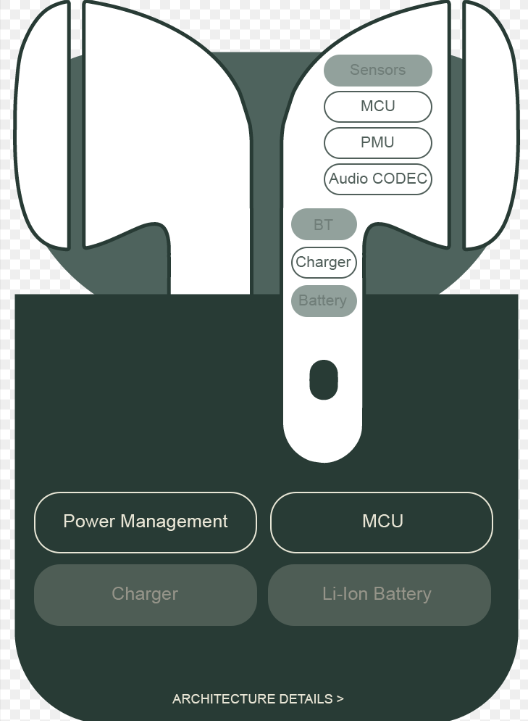
- 🎧 Smart earbuds and wearables
- 🚘 Automotive voice control and in-cabin sensing
- 🧠 Edge AI and far-field voice assistants
- 🎙️ Professional audio & noise-canceling systems
🔍 Explore SiSTC’s MEMS microphone lineup for high-SNR and low-power audio sensing:
👉 https://sistc.com/product-category/mems-microphone/
Conclusion
The integration of electrostatic force feedback, sub-sampling amplitude detection, and predictive charge control in a CMOS-MEMS microphone represents a breakthrough in dynamic-range-aware audio sensing. SiSTC is actively investing in these frontier technologies to enable the next generation of adaptive, high-resolution voice interfaces.