 English
  Chinese
 Market Overview
According to Yole Développement’s report State of the MEMS Industry – 2025, the global MEMS microphone market is projected to grow from USD 1.39 billion in 2024 to USD 1.83 billion by 2030. This steady expansion is primarily driven by strong demand from smartphones, smartwatches, and true wireless stereo (TWS) earbuds, which continue to integrate more microphones per device to support advanced audio and AI-driven features.
In parallel, Yole’s MEMS Microphones, Micro-Speakers & Audio Processing ICs – 2025 report highlights that the global audio market is increasingly led by TWS and wearable devices, while AR/VR applications are expected to accelerate adoption in the coming years. Driven by advances in MEMS technology and voice interface solutions, the combined market for MEMS microphones, micro-speakers, and audio processing ICs is forecast to grow from USD 7.1 billion in 2024 to USD 9.0 billion by 2030.
External reference:
- Yole Développement official website: https://www.yolegroup.com
MEMS Microphone Technology Landscape
Against the backdrop of growing global interest in MEMS microphones, Yole released the comprehensive MEMS Microphone Comparative Analysis – 2025 report, offering an in-depth evaluation of 11 leading MEMS microphone products. The analysis covers technology choices, supply chains, and cost structures, with real-world applications in flagship devices such as the Apple iPhone 16 Pro Max, Samsung Galaxy S24 Ultra, and a wide range of wearable electronics.
The manufacturers covered in the comparison include:
- Knowles
- Goermicro
- AAC Technologies
- STMicroelectronics
- Silicon Source Technology Co., Ltd. (SISTC)
- TDK InvenSense
Internal links:
- SISTC MEMS microphone product portfolio: https://www.sistc.com/product-category/sensor-module/
Key Technology Shifts and Innovations
1. Advanced Packaging Integration
The report highlights significant evolution in MEMS microphone packaging architectures, including:
- Increased adoption of SMD (Surface-Mounted Devices) and IPD (Integrated Passive Devices) inside microphone packages
- Higher system-level integration, enabling smaller PCB footprints and lower overall BOM cost
2. Sealed Dual Membrane (SDM) Structures
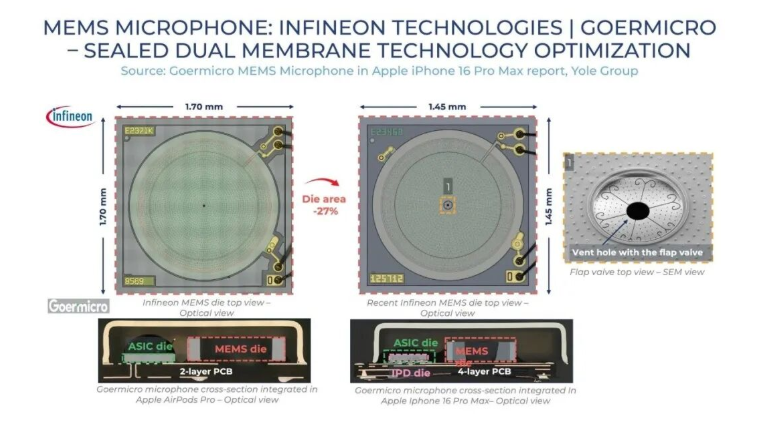
One of the most notable developments is Infineon’s next-generation Sealed Dual Membrane (SDM) MEMS architecture:
- MEMS chip design has evolved from single-backplate structures to sealed dual-membrane configurations
- This approach significantly improves robustness, humidity resistance, and long-term stability in demanding acoustic environments
Several MEMS microphones from Goermicro analyzed in the report already adopt Infineon’s SDM-based MEMS die, indicating that this architecture is moving toward large-scale commercialization.
3. AI-Enabled MEMS Microphones
The report also underscores the rapid convergence of AI and MEMS microphone technologies, particularly at the sensor edge:
- Support for always-on voice trigger and keyword spotting
- Enhanced noise suppression, echo cancellation, and sound source localization
- Ultra-low-power operation optimized for wearables, smart home devices, and AR/VR platforms
Manufacturing Processes and Cost Structure Comparison
Through detailed teardown and reverse-costing analysis, Yole provides valuable insights into how different MEMS microphone suppliers optimize performance and cost, including:
- Package type and form factor comparisons (LGA, SMD, etc.)
- MEMS die size, structure, and layout differences
- ASIC process nodes (e.g., 180 nm, 130 nm)
- Wafer substrate selection (SOI vs. bulk silicon)
- A detailed cost breakdown covering MEMS die fabrication, ASIC die, testing, and packaging
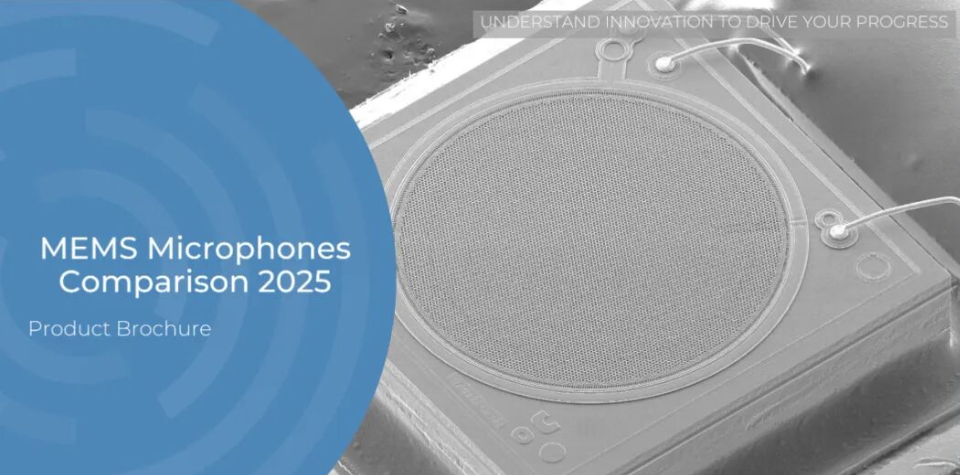
The report is further enriched by optical microscopy images and scanning electron microscope (SEM) images, offering direct visibility into structural and process-level differentiation among vendors.
SISTC Perspective & Technology Roadmap
From SISTC’s perspective, the findings of the MEMS Microphone Comparative Analysis – 2025 confirm several long-term industry directions:
- High performance, ultra-low power, and high reliability will remain the defining metrics for next-generation MEMS microphones.
- Advanced MEMS structures (such as sealed dual-membrane designs) combined with highly integrated ASICs are becoming the mainstream solution for premium and mid-range devices.
- Cost efficiency at scale—from wafer selection to packaging and test—will be a decisive factor in expanding MEMS microphone adoption beyond flagship products.
Aligned with these trends, Silicon Source Technology Co., Ltd. (SISTC) continues to invest in:
- Proprietary MEMS microphone structural design and process optimization
- Co-design of MEMS + ASIC for improved acoustic performance and lower system power
- Scalable advanced packaging technologies to balance miniaturization, yield, and cost
- MEMS microphones optimized for AI voice interfaces, wearables, and next-generation smart devices
SISTC’s technology roadmap focuses on delivering high-SNR, low-current, and robust MEMS microphone solutions that can be reliably mass-produced for global customers.
Internal links:
- SISTC official website: https://www.sistc.com
- Smart MEMS Microphone solutions: https://www.sistc.com/product/smart-mems-microphone/
Conclusion
As smartphones, wearables, and AR/VR platforms continue to evolve, MEMS microphones are transitioning from basic acoustic components into critical front-end sensors for intelligent human–machine interaction. Yole’s 2025 comparative analysis provides a clear view of how technology innovation, manufacturing strategy, and cost control are shaping the competitive landscape.
By aligning its technology roadmap with these industry trends, SISTC is well positioned to support the next wave of intelligent audio applications and to collaborate with ecosystem partners worldwide in advancing MEMS microphone technology.