


Introduction
Always‑on voice interaction has become a core requirement in smart home devices, wearables, AR/VR, and battery‑powered consumer electronics. Designers face a key challenge: how to keep the system listening continuously while minimizing power consumption.
The WBC‑HRA381‑M10 Smart MEMS Microphone Module from Wuxi Silicon Source Technology Co., Ltd. (SISTC) addresses this challenge by integrating a high‑performance MEMS microphone with ultra‑low‑power AI processing, enabling offline wake‑word detection and voice activity detection (VAD) at microamp‑level current consumption.
This article introduces the architecture, operating modes, and application value of the WBC‑HRA381‑M10, with a focus on low power consumption and wake‑word capability.
What Is the WBC‑HRA381‑M10?
The WBC‑HRA381‑M10 is an AI‑enabled smart MEMS microphone module that combines:
- High‑SNR MEMS microphone
- Analog Signal Processing (ASP)
- Always‑on Low‑Power Neural Processor (LP‑NPU)
- Neural Processing Unit (NPU) for keyword spotting (KWS)
- Integrated power management (PMU)
Unlike conventional digital microphones that stream audio continuously to a host MCU, this module performs local inference, waking the host system only when a valid voice or keyword is detected.
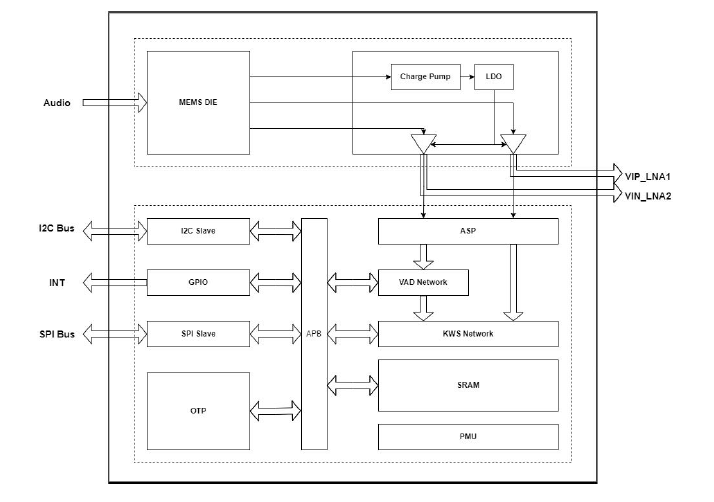
👉 Related product overview: Smart MEMS Microphone
Key Features at a Glance
1. Ultra‑Low Power Always‑On Operation
Power consumption is critical for battery‑powered and always‑listening devices:
- VAD mode: ~70 µA
- KWS active mode: ~160–170 µA
By using an event‑driven analog front‑end and LP‑NPU, the microphone remains active 24/7 without draining system power.
2. Integrated Wake‑Word & Voice Detection
The module supports offline voice intelligence:
- Built‑in Voice Activity Detection (VAD)
- Keyword Spotting (KWS) with support for up to 30 predefined wake words
- No cloud connection required
This makes it ideal for privacy‑sensitive applications and products that must respond instantly.
3. High Acoustic Performance
Despite its low power consumption, the acoustic performance remains strong:
- SNR: 65 dBA
- Acoustic Overload Point: 129 dBSPL
- Sensitivity tolerance: ±1 dB
- Omnidirectional response
This ensures reliable wake‑word detection even in noisy environments.
4. Compact Module for Space‑Constrained Designs
- Package size: 3.5 × 2.65 × 1.0 mm
- Optimized for wearables, earbuds, and compact IoT devices
Intelligent Architecture: How Low Power Wake‑Word Works
Always‑On LP‑NPU (Event‑Driven)
The LP‑NPU continuously monitors audio features using a lightweight binary neural network. It operates at extremely low power and stays active at all times.
- Detects human voice presence (VAD)
- Filters out steady‑state background noise
- Triggers system wake‑up only when needed
Hierarchical AI Processing
- VAD Mode: LP‑NPU listens continuously (~70 µA)
- Wake Event: Human voice detected
- KWS Mode: Main NPU activates to recognize keywords
- Interrupt Output: Host MCU wakes and takes action
This hierarchical AI approach dramatically reduces average system power consumption.
Operating Modes
Voice Activity Detection (VAD Mode)
- Always‑on listening
- Interrupt output when speech is detected
- Ideal for ultra‑low‑power standby systems
Continuous Keyword Spotting (KWS Mode)
- Continuous keyword inference
- Slightly higher power consumption
- Suitable when immediate voice command response is required
Ultra‑Low Power Wake‑Word Mode (VAD + KWS)
- Default low‑power VAD monitoring
- Automatic switch to KWS only after voice detection
- Best balance of responsiveness and battery life
Typical Applications
The WBC‑HRA381‑M10 is designed for a wide range of AI audio products:
- Smart speakers & smart home controllers
- TWS earbuds and headphones
- Smartwatches and fitness wearables
- AR/VR glasses
- Smartphones & tablets
- Battery‑powered IoT devices
For more background on wake‑word technology, see:
- External reference: Keyword Spotting for Embedded Systems (TensorFlow Lite Micro documentation)
- External reference: Voice Activity Detection Overview (IEEE Signal Processing Magazine)
Design & Integration Benefits
- I2C interface for simple host communication
- Interrupt‑based wake‑up signals
- Reduced MCU load and system BOM
- Faster time‑to‑market for voice‑enabled products
By embedding intelligence directly into the microphone, system designers can simplify firmware, reduce power budgets, and improve user experience.
Conclusion
The WBC‑HRA381‑M10 Smart MEMS Microphone Module represents a new generation of always‑on, ultra‑low‑power voice interfaces. By combining high‑quality acoustics with integrated AI wake‑word processing, it enables designers to build responsive, private, and energy‑efficient voice‑controlled products.
If you are developing next‑generation smart devices that rely on low power consumption and reliable wake‑word detection, this module provides a compelling solution.
👉 Learn more about SISTC smart microphone solutions:
https://sistc.com/product/smart-mems-microphone/