

Smart MEMS Microphones Enable High-Precision Acoustic Ranging: From FMCW to BeepBeep
Published by Wuxi Silicon Source Technology Co., Ltd.
🔗 Smart MEMS Microphone Product Page →
Introduction: Acoustic Ranging Meets Smart MEMS Microphones
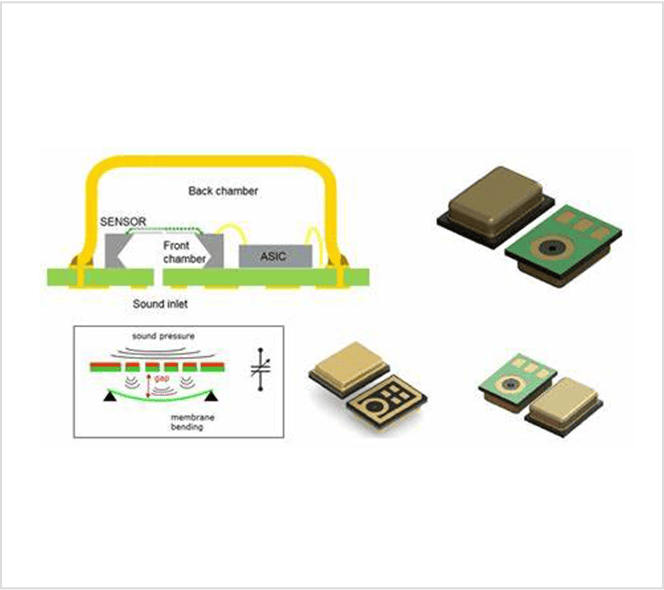
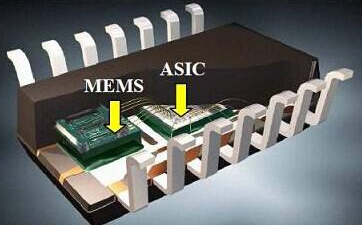
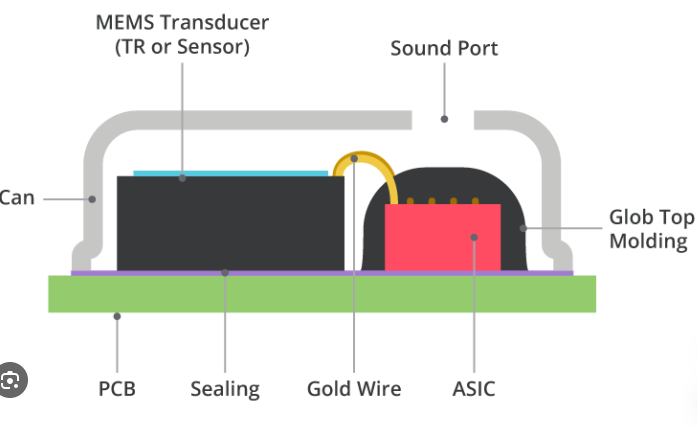
As intelligent sensing continues to evolve, Smart MEMS Microphones are stepping beyond simple audio capture — they are becoming precise measurement and positioning instruments.
One of the most exciting areas of innovation is acoustic distance measurement (sound-based ranging), where MEMS microphones detect sound propagation time to calculate distance with sub-centimeter precision.
At Wuxi Silicon Source Technology (SISTC), our research integrates acoustic signal processing, MEMS sensing, and AI edge computing, enabling next-generation devices to perform real-time spatial awareness and motion tracking.
This article introduces two representative acoustic ranging techniques based on Time of Flight (ToF):
- FMCW (Frequency-Modulated Continuous Wave) Ranging
- BeepBeep Two-Way Acoustic Ranging

1. FMCW Acoustic Ranging: Precision Through Frequency Difference
FMCW (Frequency-Modulated Continuous Wave) ranging measures distance by analyzing the frequency shift between a transmitted and reflected sound wave.
In this method, an audio source (speaker) emits a chirp signal whose frequency increases linearly with time. When the sound reflects off a surface, the receiver (equipped with a MEMS microphone) records both the original and reflected signals.
By comparing these two signals — specifically, their beat frequency (Δf) — we can calculate the time delay (td), and thus the distance (R): R=c⋅Δf⋅TBR = \frac{c \cdot \Delta f \cdot T}{B}R=Bc⋅Δf⋅T
Where:
- c = speed of sound
- B = bandwidth of frequency sweep
- T = sweep period
The higher the frequency resolution and signal-to-noise ratio (SNR) of the MEMS microphone, the more accurate the result.
Our Smart MEMS Microphones offer high SNR, low self-noise, and ultra-fast transient response, which are ideal for capturing subtle frequency shifts in FMCW applications.
🔗 Learn more about SISTC’s high-performance Smart MEMS microphones:
https://sistc.com/product/smart-mems-microphone/
2. BeepBeep: Two-Way Acoustic Ranging Without Clock Synchronization
The BeepBeep system, first proposed by Peng et al. (2007) [1], introduced a simple yet elegant approach to measuring distance between two devices — without requiring precise time synchronization.


Here’s how it works:
- Device A sends a chirp sound at time tA₀, received by both itself (tA₁) and Device B (tB₁).
- Device B then emits its own chirp at tB₂, received by both itself (tB₃) and Device A (tA₃).
- The devices compute the difference between send/receive intervals locally, then exchange timing data to estimate distance.
The beauty of BeepBeep lies in its ability to eliminate hardware clock drift, since each device relies only on local time differences.
This makes the method highly compatible with commercial mobile hardware, especially smartphones and IoT devices that integrate Smart MEMS Microphones.
When implemented on phones, this approach uses the same MEMS microphone and speaker to perform bi-directional acoustic communication, enabling high-accuracy localization with minimal additional hardware.
3. Real-World Applications: Smart MEMS Microphones in Action
The convergence of acoustic ranging and MEMS technology opens new opportunities for:
- Indoor positioning systems (e.g., in retail, robotics, and AR/VR)
- Gesture recognition through sound reflection
- Touchless control interfaces powered by ultrasonic sensing
- Wearable fitness devices that track motion via acoustic feedback
- Smart home devices capable of real-time spatial awareness
SISTC’s Smart MEMS Microphone Series provides:
- High sensitivity and wide bandwidth (up to 20 kHz+)
- Excellent linearity under dynamic sound pressure
- Low power consumption for edge AI devices
- Compact design ideal for integration into consumer electronics
💡 Explore how SISTC’s MEMS microphones are transforming smart sensing and spatial perception across consumer electronics, IoT, and wearables.
🔗 Visit Smart MEMS Microphone Product Page →
4. Future Outlook: Edge AI + MEMS for Context-Aware Intelligence
By combining Edge AI with Smart MEMS Microphones, next-generation devices can understand and react to their surroundings in real time.
Whether it’s a smart speaker detecting user presence or a robot mapping its environment using acoustic feedback, MEMS microphones are evolving into intelligent spatial sensors.
The ongoing miniaturization of MEMS technology and the integration of machine learning algorithms directly on edge processors are paving the way for autonomous sensing systems capable of real-time context awareness.
At SISTC, we continue to explore multimodal sensor fusion, combining MEMS microphones, IMUs, and optical sensors to power the next generation of smart consumer devices.
References
[1] Peng, C., Shen, G., Zhang, Y., Li, Y., & Tan, K. (2007). BeepBeep: A High Accuracy Acoustic Ranging System Using COTS Mobile Devices. Proceedings of SenSys 2007.
🔗 https://doi.org/10.1145/1322263.1322265