

As voice interaction becomes the primary interface for smart devices, traditional dual-microphone systems are no longer sufficient.
To achieve:
- Far-field voice pickup
- Accurate speech recognition
- Robust noise suppression
modern systems are rapidly shifting toward multi-microphone arrays (4, 6, or 8 microphones).
This is where true AI-powered audio perception begins.
Why Multi-Mic Arrays Matter
Compared to dual-mic systems, multi-mic arrays provide:
Higher Directivity
More microphones = sharper beamforming focus
Better Noise Suppression
Spatial filtering becomes significantly more effective
Sound Source Localization
Ability to detect where sound is coming from
Improved AI Recognition Accuracy
Cleaner input dramatically boosts ASR (Automatic Speech Recognition)
Common Array Configurations
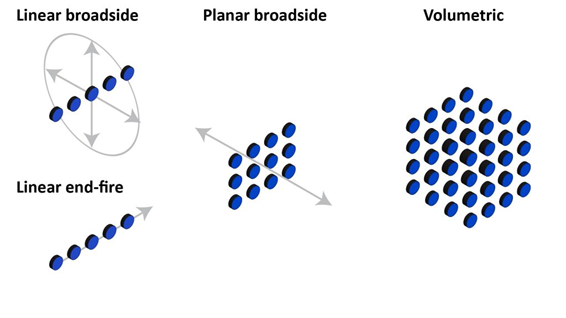
1. Linear Array (1D)
Structure:
Microphones arranged in a straight line
Advantages:
- Simple design
- Easy signal processing
Limitations:
- Limited angular resolution
- Poor 3D localization
2. Planar Array (2D)
Structure:
Microphones arranged in a plane (circular, rectangular)
Advantages:
- Full spatial coverage
- Better beam steering
- Accurate localization
Typical Use Cases:
- Smart speakers
- Conference systems
- AIoT control panels
3. Circular Array (Most Popular)
Structure:
Microphones arranged in a ring
Advantages:
- 360° voice pickup
- Uniform directional response
- Ideal for wake-word detection
From Beamforming to AI Audio Intelligence
Multi-mic arrays enable more than just directional pickup—they enable audio intelligence.
Key technologies include:
- Adaptive beamforming
- Acoustic echo cancellation (AEC)
- Noise reduction (NR)
- Voice activity detection (VAD)
- Sound source localization (SSL)
These technologies work together to transform raw audio into clean, structured voice data for AI systems.
Far-Field Voice Pickup: The Real Challenge
In real-world environments, voice signals face:
- Background noise
- Reverberation
- Interference from multiple speakers
Multi-mic arrays solve this by:
👉 Focusing on the target direction
👉 Suppressing off-axis noise
👉 Enhancing speech clarity
This is essential for:
- Smart home control
- In-car voice systems
- Industrial voice interfaces
Engineering Challenges in Multi-Mic Design
While powerful, multi-mic arrays introduce complexity:
1. Synchronization
All microphones must be precisely aligned in time
2. Calibration
Small sensitivity differences can degrade performance
3. Processing Power
More channels require more DSP/AI computation
4. Power Consumption
Critical for battery-powered devices
How SISTC Enables High-Performance Array Systems
At SISTC, we provide end-to-end solutions that bridge hardware and AI:
High-Consistency MEMS Microphones
👉 https://sistc.com/product-category/mems-microphone/
- Tight sensitivity tolerance
- Low noise floor
- Excellent phase consistency
Integrated AI Audio Modules
👉 https://sistc.com/product-category/sensor-module/
- Built-in beamforming
- AI noise reduction
- Wake-word support
- Plug-and-play integration
Hardware + Algorithm Co-Design
We combine:
- MEMS microphone arrays
- Signal conditioning circuits
- Low-power processing modules
to deliver optimized acoustic performance with minimal system complexity.
Real-World Applications
Multi-microphone arrays are now essential in:
Smart Home Devices
- Smart speakers
- Voice-controlled appliances
Automotive Systems
- In-cabin voice control
- Driver monitoring
Industrial Equipment
- Voice-operated machinery
- Hands-free control systems
Consumer Electronics
- ANC headphones
- AR/VR devices
Why Multi-Mic Arrays Are the Future
As AI continues to evolve, devices must not only “hear” but also understand context and environment.
Multi-microphone systems provide the foundation for:
- Spatial awareness
- Context-aware AI
- Natural human-machine interaction
Conclusion
Multi-microphone arrays represent the next stage of audio evolution.
By combining:
- Advanced beamforming
- AI-driven algorithms
- High-performance MEMS hardware
they enable truly intelligent voice systems.
SISTC is committed to delivering cutting-edge MEMS microphone and AI audio solutions that power the next generation of smart devices.
References
- Iain McCowan, “Microphone Arrays : A Tutorial,” April 2001, available at http://www.aplu.ch/home/download/microphone_array.pdf [accessed June 2021]. Detailed, math-intensive treatise on array microphones.
- Sverre Holm, “Differential arrays – from cardioid microphones to Yagi antennas,” Department of Informatics, University of Oslo, available at https://www.mn.uio.no/fysikk/english/people/aca/sverre/lecturenotes/2020-differentialarrays-cardioid-yagi.pdf [accessed June 2021]. Extremely useful and understandable reference on differential microphone arrays.