


How MEMS Microphone Arrays Are Transforming Near-Field Acoustic Imaging in Real Industrial Environments
As industries move toward smarter diagnostics, AI-driven acoustic sensing, and high-resolution sound source localization, engineers increasingly rely on near-field acoustic holography (PNAH) and beamforming microphone arrays to visualize sound fields with precision.
However, traditional single-layer acoustic measurement systems often struggle in real-world noisy environments.
Factory machinery, automotive reflections, wind tunnel turbulence, and rear-side interference can severely distort reconstructed acoustic images.
Today, a new generation of multi-layer MEMS microphone arrays is solving this challenge.
By combining:
- Multi-plane acoustic sensing
- High-density MEMS microphone arrays
- Advanced wavefield reconstruction algorithms
- Directional beamforming
- AI-assisted signal processing
engineers can now achieve dramatically improved acoustic holography accuracy — even in highly noisy environments.
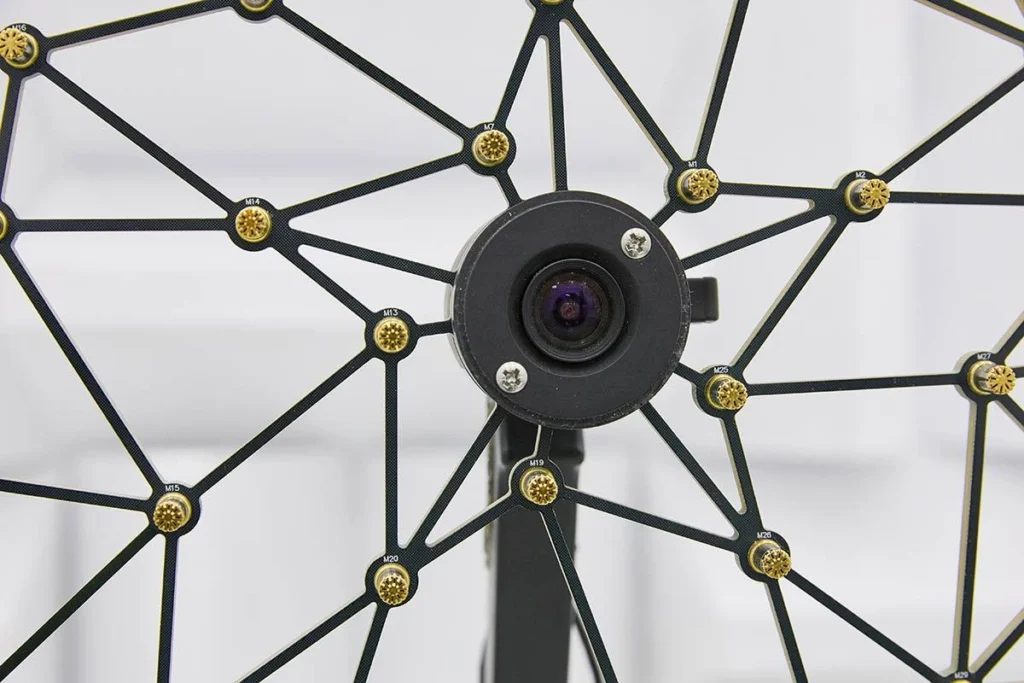
At SISTC (Wuxi Silicon Source Technology Co., Ltd.), we specialize in high-performance MEMS microphone array solutions for:
- Acoustic imaging
- Beamforming
- Far-field voice capture
- Industrial diagnostics
- Smart conference systems
- AI audio processing
- Edge acoustic sensing
Why Traditional Single-Layer Acoustic Holography Fails in Noisy Environments
Conventional planar near-field acoustic holography (PNAH) assumes that sound waves mainly arrive from one direction.
This assumption works in ideal acoustic labs.
But real-world environments are rarely ideal.
Typical challenges include:
- Mechanical noise behind the array
- Wall reflections
- Multiple sound sources
- Vehicle cabin reverberation
- Factory floor interference
- Wind tunnel background noise
When interference propagates from behind the microphone array, single-layer systems cannot distinguish:
- Desired forward-propagating waves
- Undesired backward-propagating noise
The result is:
❌ Ghost acoustic images
❌ Poor source localization
❌ Distorted phase reconstruction
❌ Reduced spatial resolution
❌ Unstable acoustic holograms
This is one of the biggest limitations in modern acoustic imaging systems.
The Multi-Layer MEMS Array Solution
Multi-layer PNAH extends traditional holography by using multiple MEMS microphone array planes positioned at different distances from the sound source.
Instead of relying on one pressure measurement layer, engineers can deploy:
- 2-layer microphone arrays
- 3-layer acoustic holography systems
- Dense multi-plane beamforming architectures
Each additional layer provides extra spatial information.
This allows advanced algorithms to:
✅ Separate forward and backward wavefields
✅ Reject rear-side interference
✅ Improve reconstruction robustness
✅ Increase beamforming precision
✅ Enhance sound source localization accuracy
The key principle is simple:
More measurement planes provide more directional acoustic information.
This fundamentally improves acoustic reconstruction quality.
Why MEMS Microphones Are Ideal for Multi-Layer Acoustic Arrays
Modern MEMS microphones are enabling practical deployment of high-channel-count acoustic imaging systems.
Compared with traditional condenser microphones, MEMS technology offers major advantages.
1. Compact Size Enables Dense Acoustic Sampling
MEMS microphones allow engineers to build:
- Thin planar arrays
- Portable acoustic cameras
- High-density beamforming systems
- Embedded industrial sensing platforms
This improves spatial resolution for:
- Acoustic holography
- Beamforming
- Noise source localization
- AI sound classification
Explore SISTC MEMS array solutions:
SISTC Microphone Array Modules
2. Excellent Phase Matching for Holography
Phase consistency is critical in near-field acoustic reconstruction.
SISTC MEMS microphone arrays are optimized for:
- Stable phase response
- Multi-channel synchronization
- Beamforming applications
- AI voice processing
- Acoustic imaging systems
This improves:
- Wavefield separation
- Direction-of-arrival (DOA) estimation
- Holographic reconstruction accuracy
3. Cost-Effective High-Channel Acoustic Systems
Traditional acoustic cameras using precision condenser microphones become extremely expensive at high channel counts.
MEMS technology dramatically reduces deployment cost for:
- 16-channel arrays
- 32-channel beamforming systems
- 64-channel acoustic cameras
- Multi-layer industrial diagnostics
This makes scalable acoustic imaging commercially viable.
4. Easy Integration with DSP and AI Platforms
Modern MEMS arrays integrate easily with:
- XMOS audio processors
- Edge AI MCUs
- FPGA systems
- Linux audio platforms
- Real-time beamforming engines
SISTC also provides microphone array solutions optimized for:
- AI voice interaction
- Acoustic beamforming
- Far-field pickup
- Smart conference systems
Related solution:
Practical Multi-Layer MEMS Array Architecture
Recommended System Structure
A typical multi-layer acoustic holography setup includes:
| Component | Recommended Configuration |
|---|---|
| Array type | Planar MEMS microphone array |
| Channel count | 16–128 microphones |
| Layer spacing | 2–5 cm |
| Output interface | PDM / I2S |
| Synchronization | Shared clock |
| Processing platform | FPGA / DSP / XMOS |
| Frequency range | Depends on microphone spacing |
| Applications | Beamforming / PNAH / acoustic imaging |
Example: Multi-Layer MEMS Array Workflow
Step 1 — Build Multiple Measurement Planes
Mount multiple MEMS microphone arrays using lightweight acoustically transparent structures.
Typical spacing:
- 20–50 mm
- Optimized based on wavelength and target frequency
Step 2 — Synchronize All Channels
Accurate synchronization is essential for:
- Beamforming
- DOA estimation
- Acoustic holography
- Phase reconstruction
SISTC microphone arrays support scalable synchronous architectures suitable for advanced acoustic imaging.
Step 3 — Perform Wavefield Reconstruction
The algorithm combines measurements from all planes to separate:
- Forward-propagating acoustic energy
- Rear-side interference
- Reflected wave components
Common processing methods include:
- Spatial Fourier transform
- Wavefield extrapolation
- Inverse boundary element methods
- AI-enhanced beamforming
For deeper academic reference:
Experimental Results: Why Multi-Layer Arrays Work Better
Researchers comparing single-layer and multi-layer systems observed major improvements.
Single-Layer Array Problems
With only one array plane:
- Rear-side interference contaminated the sound field
- False hot spots appeared
- Reconstruction stability decreased
- Fine vibration details disappeared
Multi-Layer MEMS Array Improvements
Using two synchronized MEMS array planes:
✅ Rear-side noise suppression improved significantly
✅ Acoustic images became sharper
✅ Beamforming accuracy increased
✅ Spatial reconstruction stabilized
✅ Sound source localization improved
Studies reported more than:
15 dB reduction in interference energy
in critical spatial frequency regions.
Even more importantly:
Multi-layer systems improved reconstruction accuracy even in low-noise environments.
This means multi-layer MEMS arrays improve both:
- Noise robustness
- Overall acoustic imaging quality
Real-World Applications of MEMS Acoustic Arrays
Automotive NVH Testing
Separate:
- Engine noise
- Exhaust noise
- Cabin reflections
- Wind noise
for improved vehicle acoustic analysis.
Industrial Predictive Maintenance
Detect:
- Bearing failures
- Fan imbalance
- Mechanical vibration anomalies
- Abnormal acoustic signatures
without stopping nearby equipment.
Acoustic Cameras and Beamforming
MEMS microphone arrays are widely used in:
- Acoustic imaging cameras
- Sound source localization systems
- Industrial beamforming
- Smart robotics
- AI audio analytics
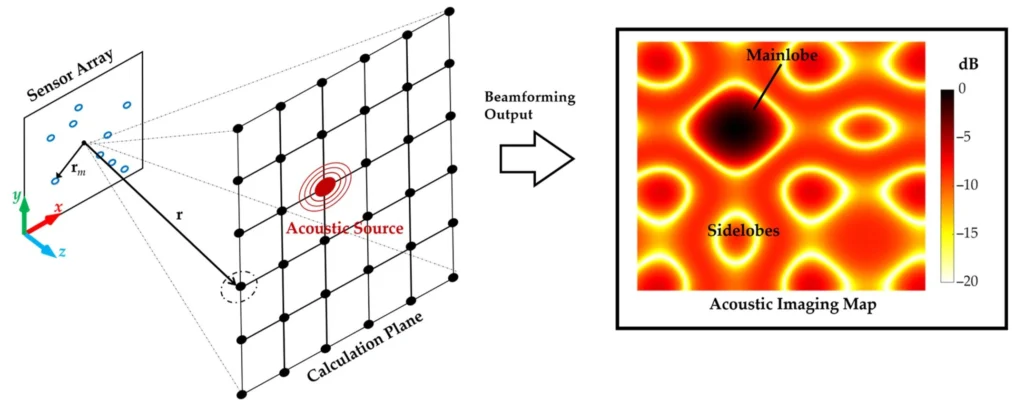
Research continues to show how microphone array geometry strongly impacts beamforming accuracy and localization performance.
Smart Conference Systems
Far-field MEMS microphone arrays improve:
- Voice pickup
- Echo cancellation
- AI meeting transcription
- Speaker tracking
- Hybrid collaboration systems
Related article:
Far-Field MEMS Arrays for Smart Conference Systems
Edge AI Audio Processing
Combining MEMS arrays with AI processors enables:
- Real-time sound classification
- Acoustic anomaly detection
- Voice interaction
- TinyML audio sensing
- Edge beamforming
Related solution:
Low-Power MEMS Microphones for Edge AI
Why Choose SISTC MEMS Microphone Arrays?
With more than 15 years of MEMS and semiconductor experience, SISTC provides scalable MEMS microphone array solutions for global OEM and industrial customers.
Our advantages include:
✅ High phase consistency MEMS arrays
✅ Beamforming-ready architectures
✅ PDM / I2S digital interfaces
✅ Far-field voice pickup optimization
✅ AI audio processing compatibility
✅ Customizable array geometry
✅ Industrial-grade reliability
✅ Support for acoustic imaging applications
Explore our full array portfolio:
SISTC Audio Sensor Array Modules
Future Trends: AI + Beamforming + Multi-Layer MEMS Arrays
The future of acoustic imaging is rapidly moving toward:
- AI-assisted beamforming
- Adaptive noise cancellation
- Real-time acoustic holography
- Smart edge sensing
- Flexible MEMS array architectures
Emerging research is exploring:
- Multi-array AI fusion
- Dynamic wavefield separation
- Self-calibrating beamforming systems
- Curved acoustic holography surfaces
As AI audio systems evolve, multi-layer MEMS arrays will become a core enabling technology.
Conclusion
Multi-layer MEMS microphone arrays are redefining the future of near-field acoustic holography and acoustic imaging.
Compared with traditional single-layer approaches, they provide:
- Better noise suppression
- Improved directional separation
- Higher beamforming accuracy
- More stable acoustic reconstruction
- Scalable high-channel architectures
Most importantly, MEMS technology makes advanced acoustic imaging systems practical, compact, and commercially deployable.
For engineers developing:
- Acoustic cameras
- Industrial diagnostics
- Automotive NVH systems
- Smart conference devices
- AI voice products
- Beamforming platforms
multi-layer MEMS microphone arrays offer a powerful path forward.