 English
  Chinese
 Introduction
As artificial intelligence moves deeper into everyday life, voice interaction has become a key element of smart devices. Traditional near-field voice pickup (such as “speaking close to the mic”) no longer meets user expectations. Users expect voice commands to work from several meters away, in noisy environments, and with multiple speakers.
To achieve this, digital MEMS microphone array technology becomes the core of far-field voice interaction.
Why Microphone Arrays Matter in AI Voice Systems
Compared to a single microphone, a microphone array enables:
- Spatial selectivity
By estimating the direction of arrival (DoA), the device enhances the user’s voice and suppresses unwanted directions. - Speaker tracking
Microphone arrays can detect where a person is speaking, even if they move around the room. - Superior voice quality in complex environments
Array processing enables 3D spatiotemporal filtering, improving:- Noise suppression
- Echo cancellation
- Reverberation suppression
- Voice separation
- Sound source localization
To explore MEMS microphone products, visit:
https://www.sistc.com/product-category/mems-microphone/
To explore microphone array modules:
https://www.sistc.com/product-category/sensor-module/
Technical Challenges in Microphone Array Processing
Even though array signal processing is widely used in radar and sonar, microphone arrays differ due to the characteristics of acoustic signals.
1. Array Modeling (Near-field vs. Far-field)
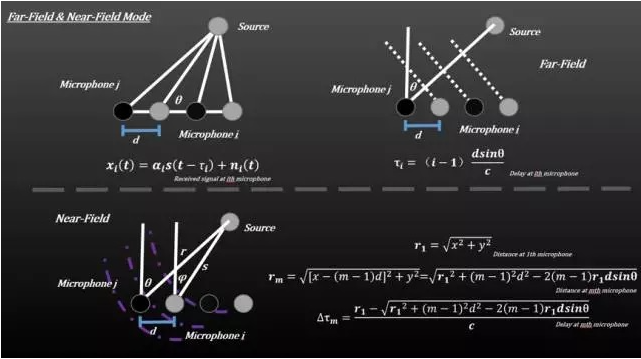
- Voice pickup typically occurs at 1–3 meters, which is near-field.
- Unlike radar/sonar far-field plane waves, audio signals are spherical waves with amplitude attenuation over distance.
2. Wideband Signal Processing
- Voice signals are naturally wideband (rich low and high frequencies).
- Delay and phase differences vary with frequency, requiring frequency-domain sub-band processing.
3. Non-stationary Signal Processing
- Speech is time-varying.
- Array algorithms process signals using Short-Time Fourier Transform (STFT) and operate per frequency bin.
4. Reverberation
- Reflections, diffraction and multiple acoustic paths decrease voice intelligibility.
- Beamforming and dereverberation algorithms are required.
Sound Source Localization
Microphone arrays determine where sound originates by converting acoustic signals into spatial coordinates (2D or 3D). This allows devices to:
- Focus beamforming on the speaker
- Track moving speakers
- Steer cameras or robots toward the speaker
There are two propagation models:
| Model | Distance | Wave Type |
|---|---|---|
| Near-field | 0–3 m (typical smart devices) | Spherical |
| Far-field | > threshold: 2L²/λ | Plane |
Where:
L = array aperture
λ = wavelength
Sound Localization Algorithms
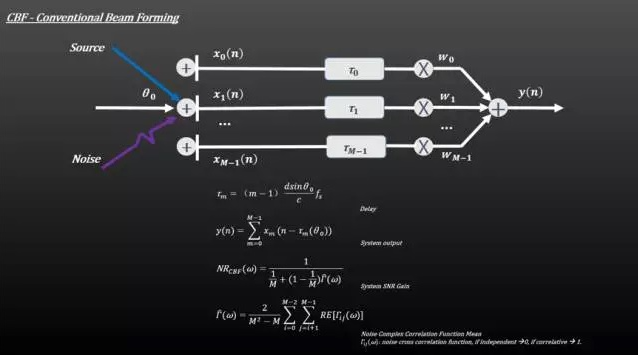
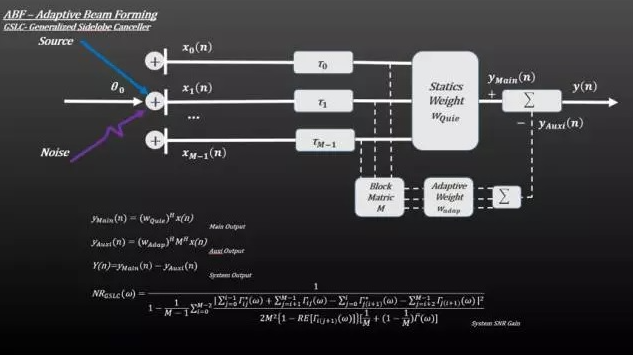
1. Beamforming (Spatial Filtering)
Two types:
| Type | Description |
|---|---|
| CBF (Conventional Beamforming) | Delay-and-sum method, simple, fixed weights |
| ABF (Adaptive Beamforming) | Self-adjusting weights, noise suppression, higher performance |
Adaptive algorithms include:
- LMS (Least Mean Squares)
- MVDR / LCMV (Minimum Variance Distortionless Response)
Key benefit:
Maximizes signal-to-noise ratio (SNR) in the direction of the speaker.
2. Super-resolution Spectrum Estimation
Algorithms such as:
| Algorithm | Advantages |
|---|---|
| MUSIC | Resolves multiple sound sources |
| ESPRIT | High resolution without physical aperture limits |
Suitable for multi-speaker environments but sensitive to model errors.
3. TDOA (Time Difference of Arrival) Based Localization
Steps:
- TDOA estimation
Using GCC-PHAT (Generalized Cross Correlation with Phase Transform)
Reference paper (IEEE):
https://ieeexplore.ieee.org/document/506206 - Position calculation
Using geometric intersection of distance differences.
Advantages:
- Requires only 3 microphones
- Low computational cost
- Excellent real-time performance
Widely used in far-field voice products (smart speakers, conference devices).
The Future of Microphone Array Technology
Microphone arrays have become the foundation for smart audio and far-field voice technology. Applications include:
- AI voice assistants
- Smart home devices
- Video conferencing
- Service robots
- Automotive voice interaction
- Wearables and hearing aids
The future trend is cross-modal fusion, combining:
- Voice recognition
- Image recognition
- Face and gesture tracking
- Beamforming and voice localization
When audio and vision work together, devices truly become intelligent.
Learn More About MEMS Microphone Arrays
Explore SISTC MEMS microphones:
https://www.sistc.com/product-category/mems-microphone/
Explore acoustic microphone array modules:
https://www.sistc.com/product-category/sensor-module/