

Introduction
In the evolving landscape of Edge AI and smart acoustics, a single microphone often falls short in noisy environments. At Wuxi Silicon Source Technology (SISTC), we’ve spent 15 years perfecting audio pickup. This guide simplifies the complex physics behind microphone arrays, explaining how multiple elements work in harmony to outperform traditional solutions.
The Core Principle: Wave Interference
A microphone array isn’t just a collection of sensors; it’s an electronic processor that utilizes the principle of wave interference.
- Constructive Interference: When sound waves from the target direction arrive in phase, their amplitudes add up, doubling the signal strength (+6 dB power gain).
- Destructive Interference: Waves from noise sources arrive at different times (phase shift), causing them to cancel each other out.
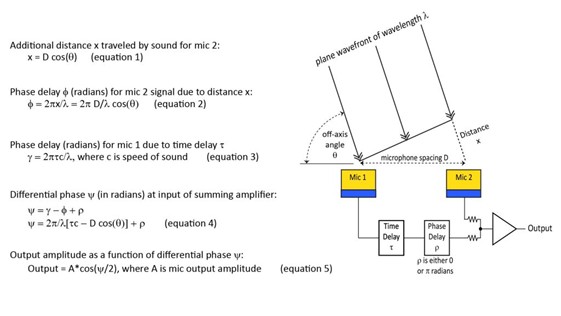
By adjusting the physical spacing and electronic time delays, we can “steer” the microphone’s sensitivity toward the user without any moving parts.
4 Critical Metrics for Array Performance
To evaluate any microphone array, you must understand these four pillars:
1. SNR (Signal-to-Noise Ratio) Gain
The primary goal of an array is to boost the desired signal while keeping self-noise low. In a standard additive array, while signal power increases by 6 dB, independent self-noise only increases by 3 dB, resulting in a net 3 dB SNR gain for a dual-mic setup. This gain increases further as more elements are added.
2. Array Factor (AF)
Think of AF as the “shape” of your microphone’s hearing. It determines how well the array suppresses off-axis noise.
- Main Lobe: The direction of maximum sensitivity.
- Side Lobes: Unwanted sensitivity in other directions.
- Grating Lobes: “Ghost” lobes that appear when microphone spacing is too wide relative to the sound’s wavelength.
3. Directivity Index (DI)
DI quantifies the array’s ability to pick up sound from the front while ignoring ambient, “isotropic” noise (like room reverb). High-quality arrays can achieve a DI far exceeding the 6 dB limit of a standard hypercardioid studio mic.
4. On-Axis Frequency Response
While a single MEMS mic might have a flat response, the array processing can introduce fluctuations. Ensuring a flat response across the human vocal range is a hallmark of SISTC’s high-precision interfaces.
Basic Building Block: The Two-Element Array
Every complex array starts with two microphones separated by a distance D.
- Broadside Arrays: Maximum sensitivity perpendicular to the mic axis. Ideal for smart TVs and laptops.
- End-fire Arrays: Maximum sensitivity along the mic axis. Perfect for handheld devices and “shotgun” style pickup.
Conclusion & Next Steps
Understanding these fundamentals is the first step toward integrating smart audio into your hardware. In our next post, we will explore Differential Arrays and how increasing the number of elements (N-elements) can dramatically sharpen your “acoustic beam.”
Looking for high-performance MEMS components for your next project? Explore our Precision MEMS Microphone Series or Contact for a technical consultation.
FAQ Module
- Q: What is the benefit of a MEMS microphone array over a single mic?
- A: It provides higher SNR, sharper polar patterns for noise reduction, and the ability to electronically steer sound pickup.
- Q: How does spacing affect microphone array performance?
- A: Larger spacing sharpens the main beam but can lead to “grating lobes” (aliasing) at high frequencies.
- Q: What is a Differential Microphone Array (DMA)?
- A: A DMA subtracts signals between mics to maintain high directivity even at low frequencies, though it requires careful frequency equalization.