 English
  Chinese
 Published: September 2025
Author: SISTC MEMS Technology Team
Website: www.sistc.com
Abstract
At SISTC, we are dedicated to advancing MEMS microphone (MEMS MIC) technology with improved stability, higher sensitivity, and stronger reliability. Recently, we developed a novel acoustic-vibration capacitive MEMS microphone, designed to capture both acoustic and low-frequency vibratory signals. This innovative MEMS sensor combines rigid diaphragms, inertial mass blocks, anti-stiction structures, and hydrophobic protective layers to enhance durability and performance.
In this blog, we share the design principles, fabrication process, performance characteristics, and application examples, such as the electronic stethoscope, to illustrate how this next-generation MEMS MIC is shaping the future of medical, industrial, and IoT sensing solutions.
1. Background and Challenges
With the rapid growth of smart devices, wearables, medical electronics, and IoT applications, MEMS microphones are widely used in smartphones, hearing aids, smart home devices, and healthcare instruments. However, conventional MEMS microphones still face challenges:
- Limited low-frequency response – most microphones are not sensitive to vibrations below 20 Hz (e.g., heart sounds).
- Environmental noise interference – air-coupled microphones are easily affected by ambient noise.
- Consistency issues – diaphragm thickness, air gaps, and mass block variations reduce manufacturing repeatability.
- Reliability – moisture, dust, and stiction during vibration may lead to performance degradation or failure.
To overcome these barriers, SISTC designed a new acoustic-vibration MEMS MIC structure.
2. Design Principles of the Acoustic-Vibration Capacitive MEMS Microphone
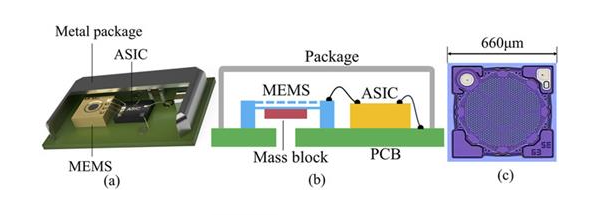
The novel design integrates capacitive sensing with mass-block-enhanced diaphragms:
- Rigid diaphragm with inertial mass blocks
Mass blocks beneath the diaphragm make the microphone sensitive not only to airborne sound but also to low-frequency surface vibrations. - Capacitive sensing structure
The diaphragm forms a variable capacitor with the backplate, where sound or vibration causes capacitance changes, generating an electrical signal. - Anti-stiction dimple array
Designed at the bottom of the diaphragm and backplate to prevent sticking failures caused by vibration. - Hydrophobic insulation layer
Added to the backplate surfaces, protecting against moisture adsorption and particle attachment. - Frequency response tuning
The thickness of the mass blocks (≈300 μm) is controlled using combined dry and wet silicon micromachining, reducing the sensing bandwidth to below 4 kHz with ±0.5 dB flatness.
3. Fabrication Highlights
- Surface micromachining – for diaphragm, electrodes, and structural layers.
- Bulk silicon micromachining – for inertial mass blocks, with precise control of thickness.
- Anti-humidity coating – extends lifetime in real-world environments.
- Wafer-level consistency – >80% process repeatability achieved on 6-inch wafers.
4. Performance Characteristics
| Parameter | Value |
|---|---|
| Open-circuit sensitivity @ 1 kHz, 94 dB SPL | ≈ 12.63 mV/Pa (37.97 dBV/Pa) |
| Total harmonic distortion (THD) | ≈ 0.21% |
| Acoustic overload point (AOP) | ≈ 121.2 dB SPL |
| Frequency bandwidth | < 4 kHz with ±0.5 dB flatness |
These results confirm that the SISTC acoustic-vibration MEMS MIC delivers low-frequency detection capability, wide dynamic range, and extremely low distortion — outperforming conventional MEMS microphones.
5. Application Example: Electronic Stethoscope
One of the most promising applications is the electronic stethoscope, where low-frequency vibrations (1–2 Hz heartbeats) contain vital diagnostic information.
Traditional microphones suppress or filter these signals, but the SISTC MEMS MIC can capture both airborne acoustic signals and mechanical vibrations, enabling clearer cardiac sound analysis for medical professionals.
👉 Related resource: MEMS microphones in medical electronics
6. Why Choose SISTC MEMS Microphones
- Dual sensitivity – captures both acoustic and vibrational signals.
- Superior low-frequency response – ideal for health monitoring and diagnostic devices.
- Wafer-level consistency – >80% reproducibility with controlled mass block thickness.
- Durability – anti-stiction structures, hydrophobic coatings, and stable silicon MEMS processes.
- Versatility – applicable to wearables, IoT devices, industrial sensing, and medical instruments.
👉 Explore our product line: MEMS Microphones – SISTC
7. Conclusion and Future Outlook
The SISTC acoustic-vibration capacitive MEMS MIC introduces a new sensing paradigm — combining acoustic precision with vibration detection. This innovation unlocks opportunities in medical diagnostics (electronic stethoscopes, hearing aids), industrial vibration monitoring, smart wearables, and IoT.
Future directions include:
- Enhancing SNR for ultra-low-noise applications
- Miniaturized packages with integrated ASICs
- Expanding frequency response for broader consumer and professional use
- Further medical validation for next-generation stethoscopes and healthcare IoT