 English
  Chinese
 Abstract
Multi-microphone arrays are increasingly replacing single-microphone solutions in modern audio systems to achieve superior acoustic performance and improved user experience. Applications such as AI voice interfaces, smart speakers, video conferencing systems, AR/VR devices, and industrial voice control require accurate voice capture even in noisy and reverberant environments.
This technical white paper explores the principles of microphone array beamforming and demonstrates how high-signal-to-noise-ratio MEMS microphones, such as the SISTC WBC Series, significantly improve array performance. By combining advanced MEMS microphone technology with modern beamforming algorithms—including Delay-and-Sum, Differential Beamforming, and MVDR—engineers can design scalable microphone arrays with higher directionality, wider bandwidth, and improved system-level SNR.
Learn more about SISTC microphone technologies:
MEMS Microphone Portfolio
https://sistc.com/product-category/mems-microphone/
Sensor & Smart Audio Modules
https://sistc.com/product-category/sensor-module/
1. Introduction
Capturing clean audio signals in real-world environments is challenging. Acoustic conditions vary widely—from quiet meeting rooms to crowded public spaces or outdoor environments affected by wind and environmental noise.
Traditional single-microphone systems cannot easily distinguish between desired signals and background noise. As a result, multi-microphone array solutions have become widely adopted across modern audio devices.
By arranging multiple microphones in a spatial configuration and applying digital signal processing algorithms, microphone arrays can:
- Enhance signal-to-noise ratio (SNR)
- Improve directional sensitivity
- Suppress environmental noise
- Enable spatial audio processing
These capabilities dramatically improve the performance of voice-driven systems such as:
- Smart speakers
- Video conferencing systems
- Automotive voice assistants
- AR/VR audio systems
- Industrial voice control devices
High-performance arrays require microphones that combine compact size, manufacturing consistency, digital output, and high SNR.
2. MEMS Microphones vs. ECM in Microphone Arrays
Historically, array designers have chosen between two main microphone technologies:
Electret Condenser Microphones (ECM)
Advantages:
- High SNR performance
Limitations:
- Larger size
- Analog output requiring external ADC
- Device-to-device variability
- Calibration complexity
- Difficult large-scale manufacturing
These limitations make ECM solutions difficult to scale for modern consumer electronics.
MEMS Microphones
MEMS microphones offer several advantages:
- Compact form factor
- Excellent device consistency
- Digital output formats (PDM, I²S, TDM)
- Surface-mount compatibility
- High-volume manufacturing capability
However, conventional MEMS microphones may have limited SNR performance, which can restrict array performance in demanding applications.
3. SISTC WBC Series MEMS Microphones
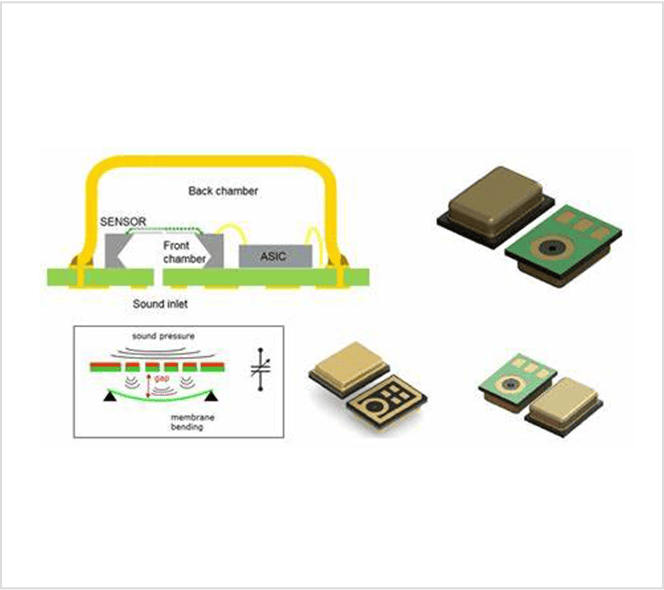
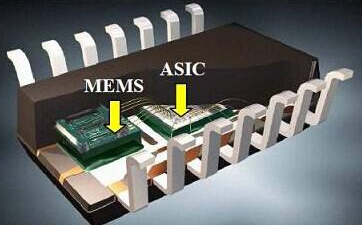
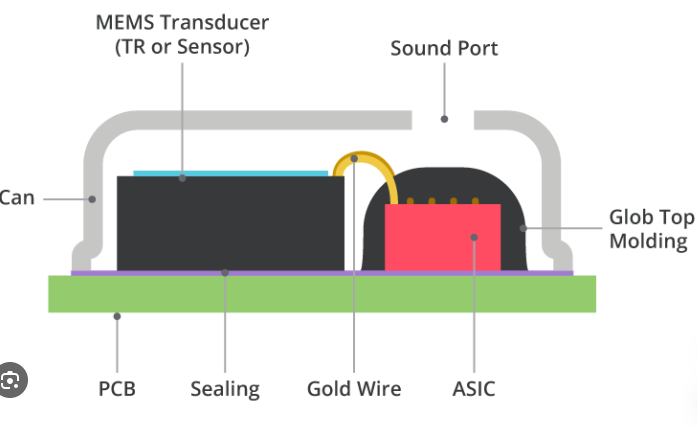
The SISTC WBC Series MEMS microphones are designed to overcome the limitations of traditional MEMS solutions.
Key features include:
- Up to 80 dBA Signal-to-Noise Ratio
- 146 dB Acoustic Overload Point
- 24-bit digital output
- Wide dynamic range up to 132 dB
- Excellent phase and sensitivity matching
These characteristics allow engineers to build scalable microphone arrays with improved performance.
Explore SISTC MEMS microphone solutions:
https://sistc.com/product-category/mems-microphone/
The WBC Series also supports highly scalable arrays, allowing multiple microphones to share digital interfaces, simplifying system integration in complex audio devices.
4. Achieving Directionality with Microphone Arrays
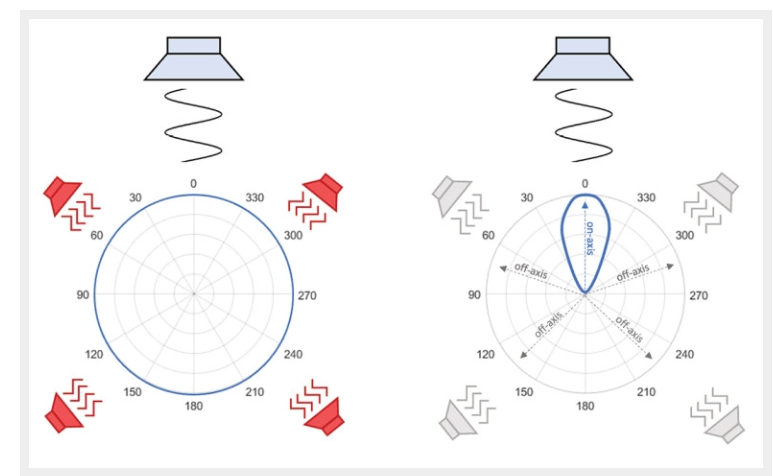
Most MEMS microphones are omnidirectional, meaning they capture sound equally from all directions.
Directional sensitivity can be achieved at the system level using microphone arrays.
When multiple microphones are placed at different spatial positions:
- Sound arrives at each microphone at slightly different times
- These delays can be processed digitally
- The system can reinforce signals from desired directions and suppress others
This forms the foundation of beamforming technology.
Microphone array beamforming enables systems to:
- Focus on a specific speaker
- Reduce background noise
- Track moving sound sources
- Improve speech intelligibility
5. Beamforming Algorithms
Beamforming is typically implemented in a DSP or SoC using various signal-processing algorithms.
The most commonly used beamforming algorithms include:
- Delay-and-Sum Beamforming
- Differential Beamforming
- Minimum Variance Distortionless Response (MVDR)
Each approach offers different trade-offs in complexity, directionality, and computational requirements.
6. Delay-and-Sum Beamforming
Delay-and-Sum is one of the simplest beamforming techniques.
Each microphone signal is delayed so that signals arriving from a desired direction align in phase. The aligned signals are then summed, reinforcing the target signal while partially canceling noise from other directions.
Advantages:
- Simple implementation
- Flat frequency response
- Improved system SNR
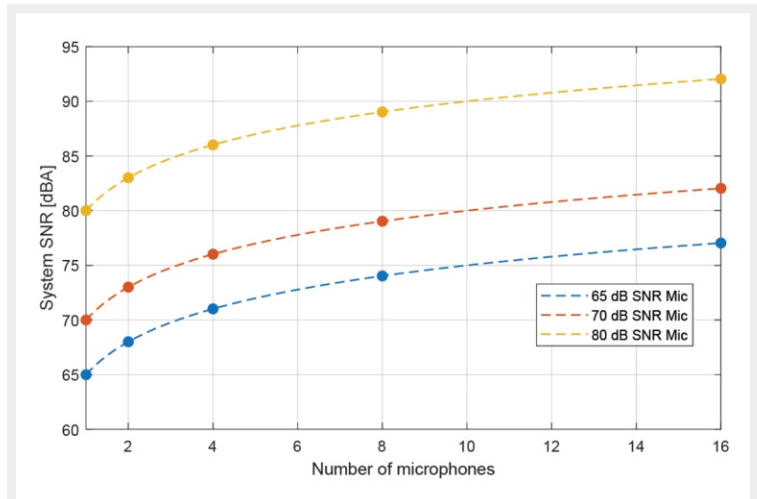
When the number of microphones doubles, the system SNR typically improves by approximately 3 dB.
However, directionality is limited, and off-axis rejection varies with frequency.
7. Differential Beamforming
Differential beamforming uses the difference between microphone signals to achieve directional sensitivity.
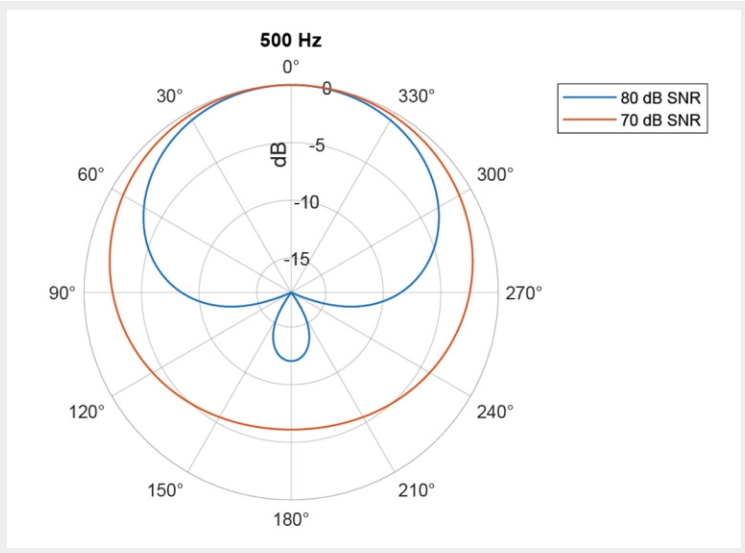
A simple two-microphone differential array can produce a cardioid pickup pattern, which significantly attenuates sounds from the rear direction.
Benefits include:
- Strong off-axis noise suppression
- Better low-frequency directionality
- Predictable directional response
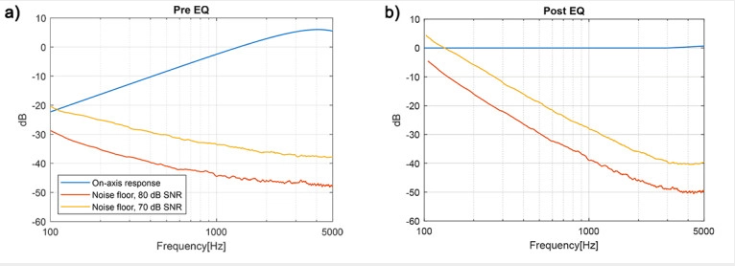
However, differential beamforming introduces a high-pass filter characteristic, which requires equalization and may increase noise levels.
Using high-SNR microphones, such as the SISTC WBC series, reduces this limitation and improves overall system performance.
8. Adaptive Beamforming (MVDR)
Minimum Variance Distortionless Response (MVDR) is a more advanced adaptive beamforming algorithm.
MVDR dynamically adjusts microphone gains and delays to:
- Maintain sensitivity toward the target signal
- Minimize interference from other directions
The algorithm analyzes incoming signals and optimizes filter parameters to suppress noise sources.
MVDR beamforming is commonly used in:
- Smart speakers
- Voice assistants
- Teleconferencing systems
- Automotive voice control
High-SNR microphones significantly improve MVDR performance by providing cleaner input signals for the algorithm.
9. Importance of High-SNR Microphones in Beamforming
Microphone self-noise directly affects array performance.
High-SNR microphones provide several advantages:
Improved System SNR
Higher microphone SNR reduces the number of microphones required to achieve a target system SNR.
Increased Bandwidth
Compact microphone spacing can maintain full audio bandwidth while preserving directionality.
Enhanced Algorithm Performance
Adaptive algorithms such as MVDR rely on accurate signal detection. Lower microphone noise allows more accurate estimation of sound direction and noise characteristics.
10. Beyond Beamforming: Complete Audio Processing
Beamforming is typically combined with other audio processing techniques, including:
- Acoustic Echo Cancellation (AEC)
- Noise Suppression
- Adaptive Interference Cancellation
These technologies work together to produce clean audio signals for communication and voice recognition systems.
Example reference implementations:
MathWorks Beamforming Overview
https://www.mathworks.com/help/phased/ug/beamforming-concepts.html
Qualcomm Smart Speaker Reference Design
https://w.dspconcepts.com/reference-designs/qualcomm-qcs400-smart-speaker-soundbar
Texas Instruments Acoustic Echo Cancellation
https://www.ti.com/video/6308400085112
11. Applications of Beamforming MEMS Microphone Arrays
High-performance MEMS microphone arrays enable advanced audio capabilities across many industries:
Smart Speakers
Far-field voice recognition and wake-word detection.
Video Conferencing Systems
Clear voice capture across meeting rooms.
Automotive Voice Interfaces
Noise-resilient voice commands in moving vehicles.
AR/VR Devices
Immersive spatial audio capture.
Industrial Voice Control
Reliable operation in noisy environments.
For integrated smart audio hardware solutions, explore:
https://sistc.com/product-category/sensor-module/
12. Conclusion
Microphone array beamforming has become essential for modern audio systems that require reliable voice capture in complex acoustic environments.
High-performance MEMS microphones—such as the SISTC WBC Series—enable significant improvements in:
- Directionality
- Signal-to-Noise Ratio
- Bandwidth
- System scalability
When combined with advanced beamforming algorithms and modern audio processing techniques, these microphones enable the next generation of intelligent voice-enabled devices.
For more information about SISTC microphone solutions and audio sensor modules, visit: www.sistc.com
References
[1] M. Suvanto, The MEMS Microphone Book, Mosomic Oy, 2021.
[2] MathWorks, “Beamforming Overview,”
https://www.mathworks.com/help/phased/ug/beamforming-concepts.html
[3] DSP Concepts, “Qualcomm QCS400 Smart Speaker/Sound Bar Reference Design,”
https://w.dspconcepts.com/reference-designs/qualcomm-qcs400-smart-speaker-soundbar
[4] Texas Instruments, “Acoustic Echo Cancellation,”
https://www.ti.com/video/6308400085112