


Introduction: The Shift Toward Far-Field Voice Interfaces
Voice has become the primary interface for next-generation devices—from smart speakers and conferencing systems to in-vehicle assistants and robotics. However, achieving accurate far-field voice pickup (3–5 meters) in noisy environments remains a major engineering challenge.
Traditional ECM microphones and even single MEMS microphones struggle with:
- Limited noise suppression
- Poor directional sensitivity
- Inconsistent performance in mass production
To overcome these limitations, engineers are increasingly adopting MEMS microphone array modules—a scalable, intelligent solution that combines hardware precision with advanced signal processing.
At SISTC, we specialize in MEMS beamforming microphone modules designed for OEM/ODM integration across smart audio applications.
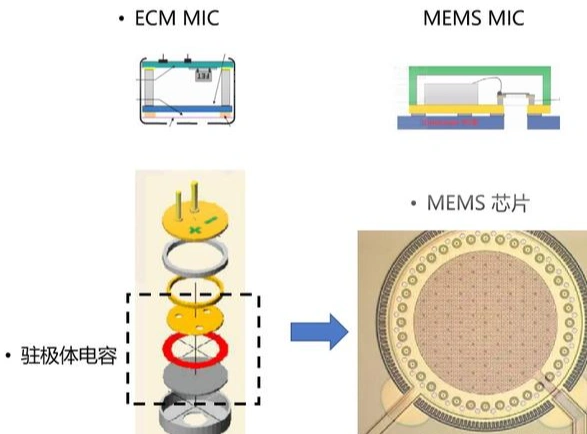
What is a MEMS Microphone Array?
A MEMS microphone array is a multi-microphone system that uses spatial signal processing algorithms—such as beamforming and noise suppression—to enhance target speech while reducing ambient noise.
Unlike single microphones, arrays enable:
- Directional audio capture
- Sound source localization
- Far-field voice recognition
Advantage 1: Superior Noise Suppression with Beamforming
One of the most important MEMS microphone array advantages is beamforming—a technique that focuses on sound from a specific direction while suppressing noise from others.
How It Works:
Multiple microphones capture sound simultaneously. By applying time-delay alignment and adaptive filtering, the system enhances the desired voice signal.
Performance Impact:
- Up to 30 dB noise reduction in real-world environments
- Significant improvement in speech recognition accuracy
👉 Compared to single microphones, MEMS beamforming microphone modules can improve wake-word detection rates by 2–3× in noisy scenarios.
Keywords integrated:
MEMS microphone array beamforming, MEMS microphone array noise suppression algorithm
Advantage 2: Accurate Sound Source Localization (360° Tracking)
MEMS arrays enable precise sound source localization, allowing devices to detect where sound is coming from.
Key Capabilities:
- 360° voice tracking
- Real-time direction detection
- Multi-speaker identification
Typical Applications:
- Smart conferencing systems
- Robotics and AI assistants
- Drone acoustic navigation
A MEMS microphone array for sound source localization transforms devices from passive listeners into spatially aware systems.
Advantage 3: Compact Design & Low Power Consumption
Built using semiconductor processes, MEMS microphones offer unmatched integration advantages over ECM.
Key Benefits:
- Ultra-compact SMD package
- Fully digital output (PDM / I2S)
- Optimized for low power consumption
This makes low power MEMS microphone array modules ideal for:
- Battery-powered devices
- Wearables and IoT products
- Edge AI systems
Advantage 4: High SNR & Far-Field Pickup Performance
Signal-to-Noise Ratio (SNR) is critical for voice capture quality.
Why Arrays Perform Better:
- Individual MEMS SNR: 65–70 dB
- Array gain improves effective SNR
- Beamforming enhances voice clarity at distance
Real-World Example:
A MEMS microphone array for smart speakers can significantly improve voice pickup accuracy at distances up to 5 meters, even in noisy environments.
Advantage 5: Production Consistency & Cost Efficiency
Consistency across microphones is essential for array performance.
MEMS Advantages:
- Semiconductor manufacturing ensures high phase consistency
- Minimal unit variation
- Reduced calibration cost
ECM Limitations:
- Large unit-to-unit variation
- Manual calibration required
- Lower scalability
👉 This makes MEMS microphone array vs ECM a clear win for large-scale production.
MEMS Microphone Array vs ECM (Quick Comparison)
| Feature | MEMS Microphone Array | ECM Microphone |
|---|---|---|
| Size | Ultra-compact (SMD) | Bulky |
| Consistency | High (wafer-level) | Low |
| Beamforming | Supported | Not supported |
| Assembly | SMT compatible | Manual |
| Noise Reduction | Advanced algorithms | Limited |
| Scalability | Excellent | Poor |
How to Choose the Right MEMS Microphone Array?
Selecting the right array depends on your application requirements.
| Application | Recommended Configuration | Key Features |
|---|---|---|
| Smart Speaker | 6–8 Mic Circular Array | 360° far-field pickup |
| Conference System | 4–6 Mic Linear Array | Directional beamforming |
| Robotics / AI | 2–4 Mic Compact Array | Localization + low power |
| Smart Home Devices | 2–4 Mic Array | Cost-effective voice control |
SISTC MEMS Microphone Array Solutions
SISTC offers a full range of MEMS microphone array modules tailored for smart audio applications.
👉 Explore our product portfolio:
https://sistc.com/product-category/sensor-module/arrays-microphone-module/
Our Key Capabilities:
- Advanced beamforming & AI noise reduction algorithms
- Flexible configurations (2 / 4 / 6 / 8 microphone arrays)
- Digital interfaces (PDM / I2S)
- OEM/ODM customization support
With over 15 years of experience in MEMS acoustic design, SISTC ensures high-performance, scalable solutions for global customers.
Conclusion: MEMS Arrays Are the Standard for AI Voice Products
As voice interaction becomes central to smart devices, MEMS microphone arrays are no longer optional—they are essential.
They deliver:
- Superior noise suppression
- Accurate sound localization
- High SNR far-field performance
- Scalable and consistent production
📩 Get Started with SISTC
Whether you’re developing a smart speaker, AI robot, or voice-enabled IoT device, SISTC can help you accelerate your product development.
Technical Support:
- Request datasheet
- Get reference design
- Apply for evaluation kit
Business Inquiry:
- Get OEM/ODM quote for MEMS microphone array module
👉 Website: https://www.sistc.com
👉 Email: denny_tan@sistc.com