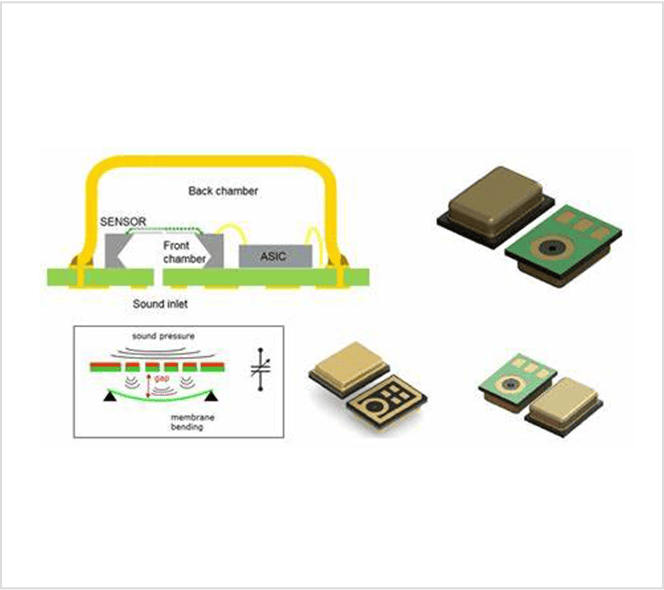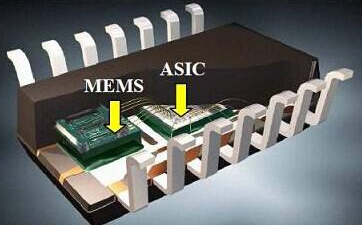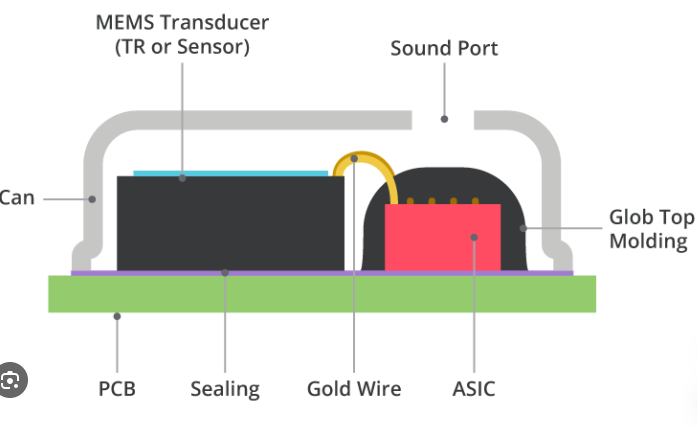


In the era of Voice AI, the expectations for smart speakers, TWS earbuds, and automotive voice interfaces have shifted. Consumers no longer accept “just hearing” a voice; they demand clear communication in wind, traffic, and crowded rooms. These demanding far-field pickup requirements expose the limitations of traditional Electret Condenser Microphones (ECM) and single-microphone setups.
To meet these challenges, the MEMS microphone array solution has emerged as the industry standard. Here are the five core advantages that make MEMS arrays the superior choice for your next smart audio project.
1. Superior Noise Suppression & Speech Enhancement (Beamforming)
The most significant edge of a MEMS microphone array is its ability to perform beamforming. Unlike a single microphone that picks up sound from all directions (including background noise), a beamforming array acts like a “sonic flashlight,” focusing on the user’s voice while digitally “nulling out” interference.
- How it works: By using a MEMS microphone array noise suppression algorithm, the system calculates the time-of-arrival difference between microphones to isolate the target signal.
- Performance: While a single mic struggles in a 75dB noisy environment, an array can maintain high speech intelligibility, ensuring your AI assistant never misses a command.
2. Precise Sound Source Localization (SSL)
Modern hardware needs to know where a sound is coming from. Whether it’s a video conferencing camera that auto-frames the speaker or a robot navigating toward a voice, MEMS microphone array for sound source localization provides the necessary spatial data.
- 360° Tracking: A circular or linear array can achieve 360° sound tracking with high angular accuracy.
- Applications: This is critical for MEMS microphone arrays for robotics and smart conference systems, allowing the device to “lock on” to a human subject amidst environmental clutter.
3. Flexible Form Factor & Low Power Design
Designers of sleek wearables and compact IoT devices often find ECMs too bulky. Digital MEMS microphone arrays offer a significant physical advantage:
- Miniaturization: MEMS components are incredibly small and utilize SMD (Surface Mount Device) technology, allowing for fully automated high-speed SMT assembly.
- Efficiency: A low power MEMS microphone array module typically features PDM (Pulse Density Modulation) output, which reduces system complexity and power consumption compared to the heavy shielding and manual soldering required for ECMs.
4. Far-Field Pickup & High Signal-to-Noise Ratio (SNR)
For a smart speaker to wake up from 5 meters away, SNR is everything. While individual high-performance mics are great, an array allows for “SNR Gain” through coherent signal summing.
- The 70dB Benchmark: Using an SNR 70dB MEMS microphone array, the effective noise floor is lowered significantly.
- The Result: Tests show that a 4-mic or 6-mic array can improve wake-word trigger rates by over 30% in far-field scenarios compared to traditional solutions.
5. Mass Production Consistency & Cost Efficiency
When building an array, phase matching is vital. If the individual microphones have different sensitivities or phase responses, the beamforming algorithm will fail.
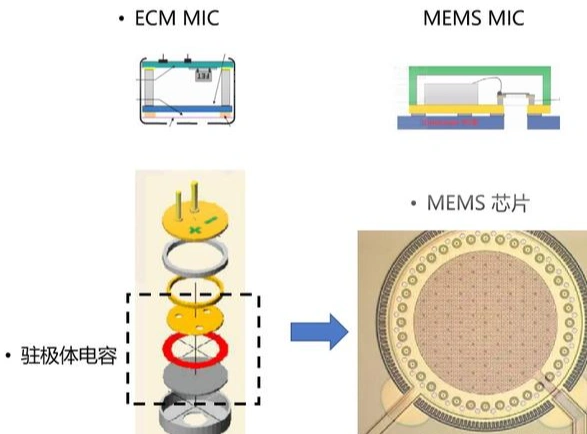
- Semiconductor Precision: Because MEMS are manufactured using a silicon wafer process, the consistency between units is remarkably high.
- MEMS microphone array vs ECM: ECMs vary wildly from batch to batch, requiring expensive individual calibration during assembly. MEMS arrays eliminate this bottleneck, lowering the total cost of ownership (TCO) for large-scale deployments.
Conclusion: The Standard for the AI Era
As voice interaction becomes the primary UI for smart devices, the move from ECM to MEMS arrays is no longer optional—it is a technical necessity. From noise suppression to spatial awareness, the MEMS array is the engine driving the next generation of acoustic performance.
As a leading custom MEMS microphone array provider in China, Wuxi Silicon Source Technology (SISTC) specializes in high-performance modules tailored to your specific hardware needs.
Ready to elevate your audio performance? Contact us today to request specifications or a sample for your project.