


MEMS Microphone Array Beamforming: Complete Engineering Guide
Introduction
Voice-controlled systems have become a fundamental interface in modern electronics. Smart speakers, AI assistants, conferencing systems, automotive voice control, and AR/VR devices all rely on accurate voice capture in complex acoustic environments.
However, real-world environments often contain:
- background noise
- reverberation
- competing speakers
- mechanical vibration
- wind noise
A MEMS microphone array combined with beamforming algorithms allows systems to isolate the desired speech signal while suppressing unwanted noise sources.
Compared with traditional single-microphone solutions, microphone arrays can significantly improve:
- Signal-to-Noise Ratio (SNR)
- Speech intelligibility
- Directional sensitivity
- Far-field voice detection
Modern arrays typically use high-performance MEMS microphones due to their small size, manufacturing consistency, and digital interface compatibility.
Explore SISTC MEMS microphone solutions:
MEMS Microphones
https://sistc.com/product-category/mems-microphone/
Smart Sensor Modules
https://sistc.com/product-category/sensor-module/
Table of Contents
- What is a MEMS Microphone Array
- Why Beamforming is Important
- MEMS vs ECM Microphones
- Beamforming Algorithms Explained
- Importance of High-SNR Microphones
- Microphone Array Design Guidelines
- Real-World Applications
- SISTC MEMS Microphone Solutions
- Frequently Asked Questions
What is a MEMS Microphone Array
A microphone array consists of multiple microphones arranged in a geometric pattern.
When sound reaches each microphone, it arrives at slightly different times depending on the sound direction. These time differences are processed using digital signal processing to determine the direction of arrival and enhance the desired signal.
Typical array geometries include:
- Linear arrays
- Circular arrays
- Planar arrays
- Distributed arrays
Microphone arrays enable advanced audio capabilities such as:
- directional sound capture
- far-field voice recognition
- spatial audio processing
- acoustic scene analysis
Why Beamforming is Important
Beamforming is the key signal-processing technique that allows microphone arrays to focus on sounds from specific directions.
Instead of capturing sound equally from all directions, a beamforming system can:
- enhance signals from the target direction
- suppress environmental noise
- reduce reverberation
- improve speech recognition accuracy
This is essential for voice-controlled devices operating in noisy environments such as:
- conference rooms
- public spaces
- vehicles
- industrial environments
MEMS Microphones vs ECM Microphones
| Feature | MEMS Microphones | ECM Microphones |
|---|---|---|
| Size | Very small | Larger |
| Manufacturing | Semiconductor process | Mechanical assembly |
| Consistency | Very high | Moderate |
| Output | Digital / Analog | Analog |
| Integration | Easy SMT assembly | Requires additional components |
| Array scalability | Excellent | Limited |
MEMS microphones have become the dominant technology for modern microphone arrays due to their scalability and integration advantages.
Beamforming Algorithms Explained
Different beamforming algorithms provide different performance characteristics.
The most widely used algorithms include:
- Delay-and-Sum Beamforming
- Differential Beamforming
- Minimum Variance Distortionless Response (MVDR)
Delay-and-Sum Beamforming
Delay-and-Sum is the simplest beamforming technique.
Each microphone signal is delayed so that sound from the target direction arrives in phase before the signals are summed.
Advantages:
- simple implementation
- low computational cost
- improved system SNR
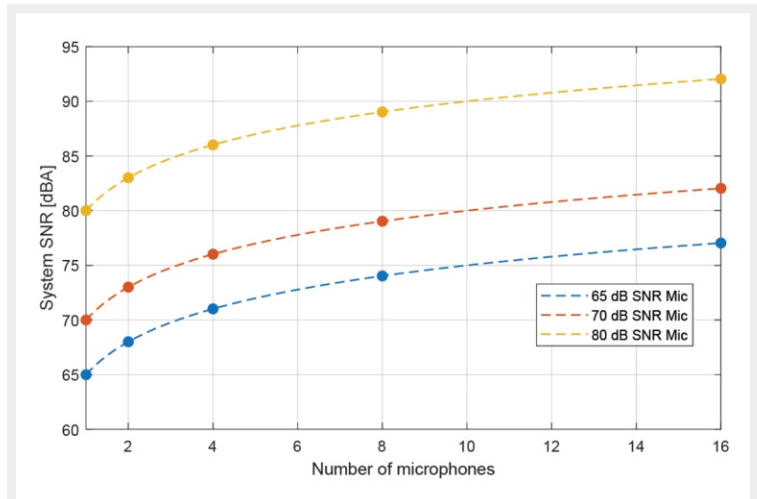
When the number of microphones doubles, the array SNR increases by approximately 3 dB.
However, directionality is limited and varies with frequency.
Differential Beamforming
Differential beamforming uses differences between microphone signals to create directional sensitivity.
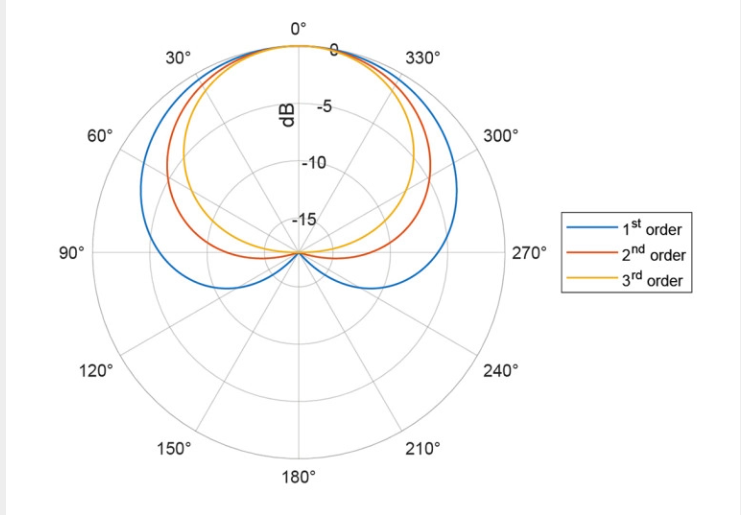
A two-microphone differential array can generate a cardioid pickup pattern, significantly reducing sound from the rear direction.
Advantages include:
- stronger off-axis noise suppression
- predictable directional response
- compact array configurations
However, differential beamforming introduces a high-pass frequency response that must be equalized.
MVDR Beamforming
Minimum Variance Distortionless Response (MVDR) is an adaptive beamforming algorithm widely used in modern voice interfaces.
MVDR dynamically adjusts microphone weights to minimize noise while preserving signals from the desired direction.
Advantages:
- adaptive noise suppression
- high directional accuracy
- improved performance in dynamic environments
MVDR is commonly used in:
- smart speakers
- conferencing systems
- automotive voice assistants
Reference:
MathWorks Beamforming Overview
https://www.mathworks.com/help/phased/ug/beamforming-concepts.html
Importance of High-SNR MEMS Microphones
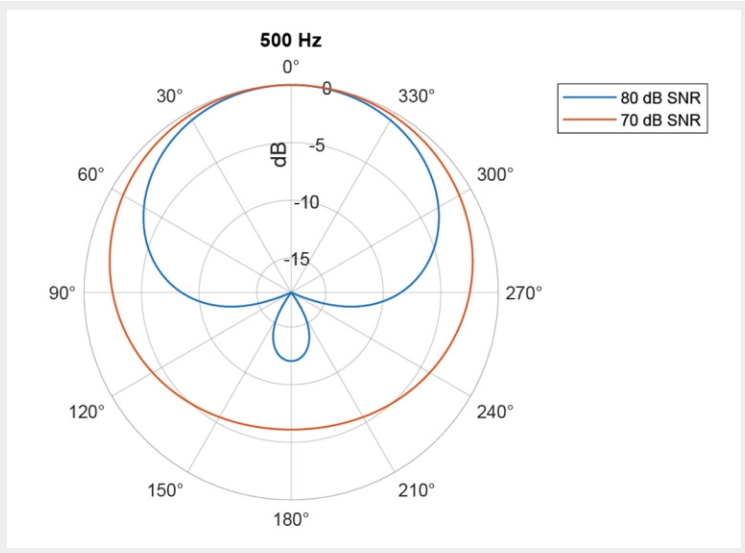
Microphone self-noise directly affects beamforming performance.
Higher SNR microphones provide:
- better beamforming accuracy
- reduced system noise floor
- improved far-field voice detection
- better performance for adaptive algorithms
High-SNR microphones also allow designers to achieve the same system SNR with fewer microphones, reducing cost and system complexity.
Microphone Array Design Guidelines
Engineers designing microphone arrays should consider several key parameters.
Microphone Spacing
Typical spacing ranges from:
5 mm – 50 mm
Spacing affects:
- spatial aliasing
- usable bandwidth
- directional performance
Number of Microphones
More microphones improve:
- beamforming precision
- noise suppression
However, they also increase:
- DSP complexity
- power consumption
Microphone Matching
Array performance depends heavily on microphone consistency.
Important parameters include:
- sensitivity matching
- phase matching
- frequency response consistency
High-quality MEMS microphones provide excellent device-to-device matching.
Real-World Applications
Beamforming MEMS microphone arrays are widely used across modern electronics.
Smart Speakers
Far-field voice capture and wake-word detection.
Video Conferencing Systems
Clear speech capture across meeting rooms.
Automotive Voice Interfaces
Reliable voice commands in noisy vehicles.
AR/VR Devices
Immersive spatial audio capture.
Industrial Voice Control
Hands-free operation in noisy environments.
Explore integrated audio sensor solutions:
https://sistc.com/product-category/sensor-module
SISTC MEMS Microphone Solutions
SISTC provides advanced MEMS microphone solutions designed for high-performance microphone arrays.
Key features include:
- high signal-to-noise ratio
- stable phase matching
- digital audio interfaces
- scalable array integration
Learn more:
MEMS Microphones
https://sistc.com/product-category/mems-microphone/
Frequently Asked Questions
What is beamforming in microphone arrays?
Beamforming is a signal-processing technique that uses multiple microphones to focus on sounds from a specific direction while suppressing noise from other directions.
Why are MEMS microphones widely used in microphone arrays?
MEMS microphones provide small size, excellent manufacturing consistency, and easy integration with digital electronics.
How many microphones are required for beamforming?
Simple arrays may use two microphones, while advanced systems may use 4–8 microphones or more depending on performance requirements.
What SNR is recommended for beamforming microphones?
Microphones with 80 dB SNR or higher are recommended for high-performance beamforming arrays.
Conclusion
Beamforming microphone arrays have become a fundamental technology for modern voice-enabled systems.
By combining advanced signal-processing algorithms with high-performance MEMS microphones, engineers can design audio systems capable of reliable voice capture even in challenging acoustic environments.
High-SNR MEMS microphones further enhance beamforming performance by reducing noise and enabling more accurate signal processing.
SISTC provides a range of MEMS microphone and sensor module solutions designed specifically for beamforming microphone arrays and AI voice applications.
Visit
https://www.sistc.com
to learn more.