


Introduction
Voice interaction in wearables and hearables faces a persistent challenge: how to capture the user’s own voice clearly while suppressing ambient noise, all under strict power and size constraints.
Conventional air-conduction microphones struggle in noisy environments. Bone conduction microphones, by contrast, sense vibration transmitted through the human body, delivering a much higher own-voice-to-noise ratio.
The WBC252-01GD Bone Conduction MEMS Microphone from Wuxi Silicon Source Technology Co., Ltd. (SISTC) is designed precisely for this purpose. With ultra-low power consumption, compact size, and high vibration sensitivity, it enables reliable voice pickup for next-generation wearable and battery-powered devices.
What Is the WBC252-01GD?
The WBC252-01GD is a MEMS-based bone conduction microphone, technically implemented as a highly sensitive accelerometer optimized for voice-band vibrations.
Instead of capturing airborne sound, it detects mechanical vibrations generated by the user’s speech through the skull or ear canal. This approach dramatically reduces the influence of environmental noise.
👉 Product page (internal link):
https://sistc.com/product/smart-mems-microphone/
Key Advantages of Bone Conduction Voice Pickup
1. Exceptional Own-Voice Clarity
Bone conduction sensing naturally attenuates ambient noise:
- High own-voice-to-environment sound ratio
- Strong noise immunity in windy or crowded environments
- Stable voice pickup even when the mouth is covered
This makes bone conduction microphones ideal for hearables, headsets, and smart wearables.
For a general explanation of bone conduction principles, see:
https://en.wikipedia.org/wiki/Bone_conduction
2. Ultra-Low Power Consumption
Power efficiency is critical for always-on wearable devices:
- Operating current: 120–200 µA
- Supply voltage: 1.6 V to 3.6 V
- Optimized for battery-powered systems
This allows the microphone to operate continuously without significantly impacting battery life.
For background on low-power sensor design in wearables:
https://www.arm.com/markets/iot/wearables
3. High Sensitivity with Low Noise
The WBC252-01GD combines vibration sensitivity with low noise performance:
- Sensitivity (Z-axis): -25 dBV/g (typ.)
- Signal-to-noise ratio: 73 dBA
- Noise density as low as 2 µg/√Hz @ 2 kHz
These characteristics ensure accurate voice extraction across the speech frequency band.
For reference on MEMS accelerometer noise and sensitivity:
https://www.analog.com/en/technical-articles/understanding-noise-in-mems-inertial-sensors.html
Typical Applications
Thanks to its robustness and efficiency, the WBC252-01GD is well suited for:
- TWS earbuds and hearables
- Hearing aids
- Smart glasses and AR wearables
- Mobile phones (noise reduction)
- Health monitoring and body vibration detection
Bone conduction sensing is increasingly adopted in voice-enabled wearables:
https://www.eetimes.com/bone-conduction-technology-expands-wearable-design-options/
System Integration Benefits
From a hardware design perspective, the WBC252-01GD offers:
- Compact package: 3.5 × 2.65 × 1.30 mm
- Simple analog output interface
- Compatibility with standard SMT reflow processes
- Easy integration with audio codecs and low-power MCUs
Design guidelines such as proper power decoupling and low-frequency roll-off filtering help achieve optimal performance in end products.
For general wearable audio system design considerations:
https://www.ti.com/lit/wp/slyt742/slyt742.pdf
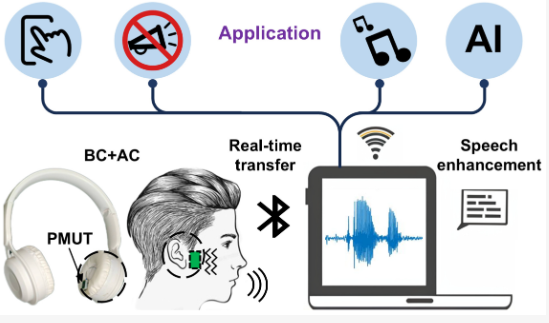
Why Bone Conduction Complements Voice AI
In modern voice-enabled systems, signal quality directly affects wake-word detection and speech recognition accuracy.
By pairing a bone conduction microphone with:
- Air-conduction microphones
- DSP noise reduction
- Edge AI or wake-word engines
designers can achieve superior voice robustness in real-world environments.
For an overview of multimicrophone voice capture strategies:
https://developer.qualcomm.com/software/voice-audio-technologies
Conclusion
The WBC252-01GD Bone Conduction MEMS Microphone delivers a powerful combination of clear own-voice pickup, ultra-low power operation, and compact form factor.
For designers of wearables, hearables, and voice-controlled devices operating in noisy environments, bone conduction technology offers a decisive advantage—and the WBC252-01GD provides a production-ready solution.
👉 Learn more about SISTC microphone solutions:
Bone-Conduction MEMS Microphone – SILICON SOURCE