


Sound source localization technology is a core component of modern digital signal processing. With the rapid development of MEMS microphones and microphone array hardware, acoustic sensing is evolving from simple sound detection to precise directional localization and spatial audio reconstruction.
Applications of sound localization technology include:
- Smart speakers, voice assistants, and wearables
- Spatial audio and VR/AR/XR systems
- Industrial monitoring, fault detection, and acoustic inspection
- Security and surveillance systems
- Automotive voice control and cabin noise detection
More information on MEMS microphone technology:
External reference – STMicroelectronics: “How MEMS microphones work”
https://www.st.com/content/st_com/en/support/learning/stm32-education/mems-microphone.html
Our company specializes in MEMS microphones and high-precision microphone array modules:
Internal link – https://sistc.com/product-category/mems-microphone/
Internal link – https://sistc.com/product-category/sensor-module/
1. Time Difference of Arrival (TDOA)
TDOA determines the location of a sound source using the arrival time difference between multiple microphones.
Principle
- MEMS microphones capture the sound signal.
- Digital signal processing calculates the arrival time difference.
- The source angle or position is derived based on geometry.

External reference – MIT OpenCourseWare: Signal Processing Using Microphone Arrays
https://ocw.mit.edu/courses/6-341-discrete-time-signal-processing-fall-2005/
Advantages:
- Low computational complexity
- Strong robustness to background noise
Limitations:
- Accuracy depends on microphone spacing and synchronization
2. Intensity Difference of Arrival (IDOA)
IDOA determines the direction of the sound source using the intensity difference received by each microphone.
Advantages:
- Suitable for environments with reflection or noise
- Works well with high-sensitivity MEMS microphones
Limitations:
- Requires calibrated microphones
- More computationally intensive than TDOA
For microphone specifications suitable for IDOA:
Internal link – https://sistc.com/product-category/mems-microphone/
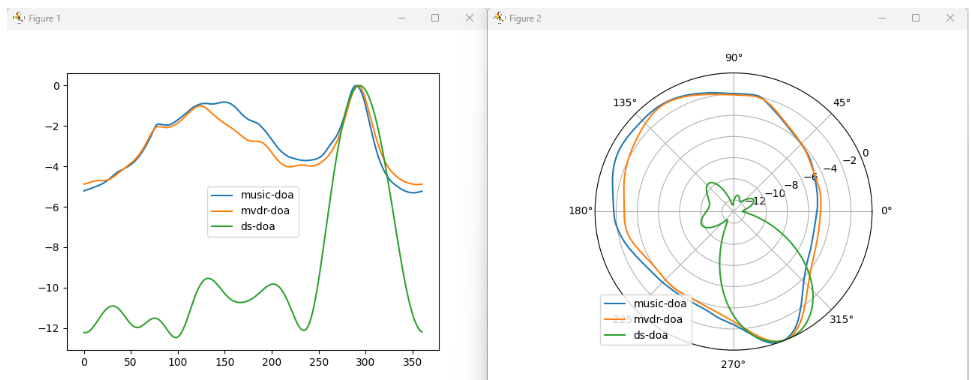
3. Cross-Correlation of Arrival (CCOA)
CCOA analyzes the correlation between multiple acoustic signals to determine the sound direction.
Process:
- Record multiple microphone audio channels
- Compute cross-correlation between microphones
- Identify the peak correlation position to determine direction
External reference – IEEE Xplore: Research on cross-correlation sound localization
https://ieeexplore.ieee.org/
Advantages:
- Higher accuracy than IDOA in complex acoustic spaces
Limitations:
- Requires precise time synchronization
4. Beamforming Algorithm (BFA)
Beamforming focuses the “listening” direction of the microphone array by controlling phase and amplitude.
Process:
- Microphone array captures sound
- Digital processing amplifies signals from the target direction
- Sound source location is determined from the beam steering angle
External reference – MathWorks: Microphone Array Beamforming Overview
https://www.mathworks.com/discovery/beamforming.html
Advantages:
- Enables directional listening and noise suppression
- Can track moving sound sources
Internal link – microphone arrays supporting beamforming:
https://sistc.com/product-category/sensor-module/
5. Deep Learning-Based Localization
Machine learning models learn sound localization patterns from large datasets and predict spatial location.
Advantages:
- Highest accuracy among all algorithms
- Learns patterns under reflective and noisy environments
Limitations:
- Requires large data volume for training
- Higher system computation and power consumption
External reference – Google AI Research on Audio-Based Localization (SoundSpaces)
https://ai.googleblog.com/2019/10/soundspaces-ai-research-in-audio-based.html
Conclusion
Sound source localization is becoming a key capability for intelligent devices. From smart home systems to automotive and industrial use cases, the combination of MEMS microphones + microphone arrays + localization algorithms enables precise spatial sound perception.
Wuxi Silicon Source Technology provides:
- MEMS microphones (high SNR, ultra-low noise)
- FPGA microphone array modules (supporting TDOA, beamforming, and AI inference)
- Custom OEM / ODM collaboration
Learn more at:
https://sistc.com/
For project inquiries, contact:
info@sistc.com