


Introduction
Sound source localization and Direction of Arrival (DOA) estimation have become crucial technologies across various applications including robotics, security systems, structural health monitoring, and smart devices. At SISTC, we specialize in developing advanced MEMS microphone solutions that power these innovative applications.
Drawing from research conducted at Illinois Institute of Technology, this article explores how MEMS-based acoustic sensor arrays can achieve high-precision sound source localization and DOA estimation in controlled environments.
Learn more about MEMS microphone technology
Understanding Sound Source Localization and DOA Estimation
Sound source localization involves determining the spatial position of an acoustic source using multiple receivers, while DOA estimation focuses solely on identifying the direction of the sound source. Both methods rely on time difference of arrival (TDOA) or phase difference information, combined with strategic sensor array geometry.
Typical implementation involves three key steps:
- Multi-channel data acquisition
- Phase or time-delay calculation
- Position or direction computation
Explore our MEMS microphone array solutions
Advanced MEMS Microphone Array Data Acquisition

The research utilized an FPGA-based system known as MEMS Array Acoustic Imaging (MASI) platform, which offers:
- Simultaneous sampling from 52 omnidirectional MEMS microphones
- Sampling rates up to 300 kSPS
- High-speed data transfer via Gigabit Ethernet
- Real-time signal processing capabilities
Built on the CAPTAN architecture, this system provides exceptional modularity and scalability for various acoustic testing scenarios.
Download our FPGA acoustic processing whitepaper
Experimental Setup: Controlled Acoustic Environment
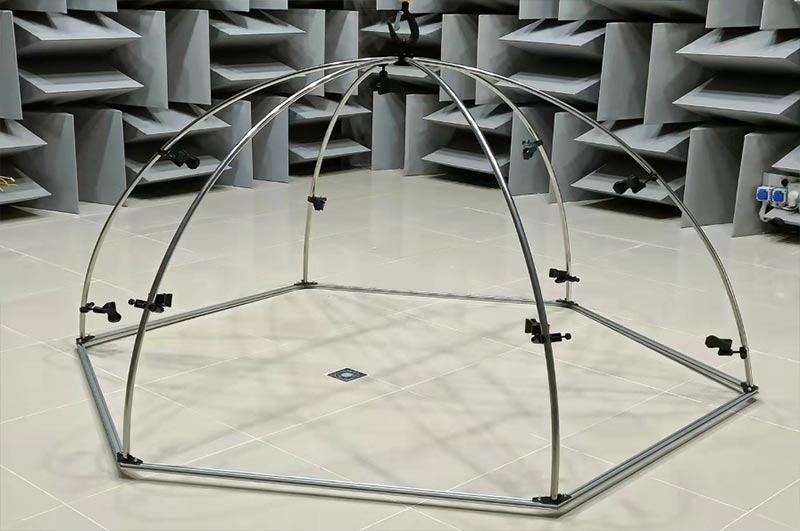
To ensure accurate measurements, researchers developed a specialized 52″×52″×27″ anechoic chamber lined with high-density polyester foam to absorb sound reflections. This controlled environment, combined with a modular sensor test stand, allowed for precise testing of various sensor configurations and geometries.
Key Experimental Findings
DOA Estimation in Reflective Environments
Initial tests in standard laboratory environments showed significant accuracy degradation due to background noise and reflections, highlighting the importance of controlled testing conditions.
Improved Accuracy in Anechoic Chamber
Moving experiments to the anechoic chamber substantially reduced reflections and improved measurement accuracy, though some systemic errors remained.
Optimized Receiver Configuration
By increasing microphone spacing, using foam isolation, and adjusting source frequencies (700Hz and 900Hz), researchers achieved significantly better alignment with theoretical values.
Pulse Signal Advantage
Using 20-cycle sine pulses and analyzing only the first arriving wavefront eliminated multipath interference, enabling highly accurate DOA estimation even at longer distances.
Ultrasonic Localization Applications
Further experiments using 40kHz ultrasonic transducers demonstrated sub-inch accuracy in both 2D and 3D localization, opening possibilities for high-precision applications in robotics and industrial automation.
See ultrasonic localization in robotics applications
Conclusion and Applications
This research demonstrates that combining MEMS microphone arrays with FPGA-based data acquisition and controlled acoustic environments enables highly accurate sound source localization and DOA estimation. Key success factors include:
- Minimizing reflections and environmental noise
- Optimizing sensor geometry and signal types
- Implementing short pulses to avoid multipath distortion
These advancements support applications in:
- Robotic auditory systems
- Voice-controlled interfaces
- Security and surveillance systems
- Industrial monitoring and automation
Contact us for custom MEMS acoustic solutions
References:
Kunin, V., Turqueti, M., Sanite, J., & Oruklu, E. (2011). Direction of Arrival Estimation and Localization Using Acoustic Sensor Arrays. Journal of Sensor Technology.
Related Content: